

.png)


See how AI-powered progress tracking helps data center teams identify schedule risks earlier and build with confidence.
Doxel is heading to Singapore for Data Centre World Asia 2026, taking place September 29–30 at the Sands Expo & Convention Centre as part of Singapore Technology Week. As an LED Wall Sponsor, Doxel will showcase how AI-powered Work-in-Place (WIP) tracking and schedule analytics help project teams identify schedule risks earlier, improve coordination, and make faster decisions throughout construction. Come visit us at booth 3G2.
Southeast Asia's data center pipeline has moved fast over the past two years. Singapore is a central hub for hyperscalers, colocation providers, and contractors racing to deliver capacity across a region where power, land, and skilled labor are tighter constraints than in more established markets.
That pressure shows up on the jobsite. Compressed schedules, fragmented regional supply chains, and delivery models that vary market to market all make it harder to know, with any confidence, where a project actually stands. Teams are still leaning on manual walk-throughs and self-reported updates to answer a basic question: is the work installed, and is it on pace with the plan?
Data Centre World Asia brings the people wrestling with that question into one room — five concurrent tracks covering the Global Stage, Keynote Theatre, Energy Security & Efficiency, Critical Infrastructure, and OCP Tech Day. It's a good cross-section of where APAC data center construction is headed, and exactly the audience we built Doxel for.
Doxel turns weekly site walks into objective, component-level progress data, tracking installed work against the plan, flagging schedule risk early, and giving owners, GCs, and trade partners a shared, factual view of where a project stands. No more disputes over whose version of “done” is right.
Teams using Doxel get:
• Automated progress tracking tied directly to the schedule
• Earlier visibility into delays, before they become critical-path problems
• A single source of truth that keeps owners, GCs, and trades aligned
• Benchmarking across projects to spot where production is slipping
For a region building as many facilities, as fast as APAC is right now, that kind of visibility isn't a nice-to-have; it's what keeps a portfolio of projects on schedule.
Doxel's team will be at booth 3G2 throughout the show: Spencer Clayton, Dom Pound-Palmieri, Jesse Gill, Hamza Abukar, and Sridhar Rengasamy, our APAC Lead. Sridhar has spent years working on large-scale infrastructure projects across Southeast Asia and is happy to share his expertise on the region.
If you're attending Data Centre World Asia and want to talk about a live or upcoming project, stop by booth 3G2 or reach out to Sridhar on LinkedIn to set up time.
We'll see you in Singapore.

LCI Congress 2026 is the place to be to see how AI-powered progress tracking gives Lean construction teams objective visibility into project progress, helping improve planning, coordination, and delivery.
Doxel is excited to return as a sponsor of LCI Congress 2026, where owners, contractors, designers, and Lean practitioners will explore the strategies and technologies shaping the future of project delivery. Taking place October 12-16, 2026, in Atlanta, Georgia, LCI Congress brings together construction leaders focused on improving collaboration, reliability, and continuous improvement.
Date: Thursday, October 15, 2026, 3:45-4:30 PM

Panelists:
- Moderator - Chris Vine, LCI-CPC, DBIA, CM-Lean Champion, Project Superintendent, Hensel Phelps
- Speaker - Brandon Bergener, Sr. Superintendent, Layton Construction Company LLC
- Speaker - John Rewolinski, Head of Schedule Analytics, Doxel
Lean construction depends on accurate, timely information. Yet many teams still rely on manual jobsite walks and spreadsheets to understand project status.
Doxel's AI-powered Work-in-Place (WIP) tracking gives Lean teams objective, real-time visibility into construction progress, helping project teams compare plan versus actual performance, improve coordination, and identify schedule risks earlier.
Whether supporting Last Planner System®, Takt planning, or flow reliability, Doxel provides trusted progress intelligence that helps teams make faster, more informed decisions.
Stop by Booth #113 to learn how leading construction teams are using AI-powered progress tracking to:
We're also proud to sponsor the LCI Congress Golf Tournament, including Hole #6 and the TaylorMade Golf Kit giveaway.
LCI Congress 2026 | October 12-16, 2026
Signia by Hilton | Atlanta, Georgia
Visit Booth #113 to how AI-powered progress tracking is helping teams deliver projects with greater certainty, consistency, and confidence.
The conference brings together leaders focused on solving the biggest challenges in AI infrastructure, including prefabrication, digital construction, power availability, and accelerated project delivery.
Doxel is heading to the Builtworlds Buildings Conference: Data Centers & AI Infrastructure to demonstrate how AI-powered progress tracking helps owners and contractors reduce schedule risk and accelerate data center delivery.
AI infrastructure projects are growing larger, faster, and more complex, making objective progress visibility more important than ever.
The event takes place September 30 to October 1 in Nashville, Tennessee. As a Premier Sponsor, Doxel will showcase how AI-powered Work-in-Place (WIP) tracking and schedule analytics help project teams identify schedule risks earlier, improve coordination, and make faster decisions throughout construction.
Thursday, October 1 | 2:10 PM – 2:50 PM

Speakers
What is reality on your jobsite? Your P6 says one thing, your trade partners say another. On a hyperscale data center, having near real-time, objective progress data helps you make better decisions to stay on schedule. In this session, a DPR superintendent and Doxel product leader share real stories from the field: catching a piping trade's slide months before it became a crisis, discovering security rough-ins installed three feet off design, and proving drywall was way ahead of schedule to a skeptical client with a single click.
Join Reid Senescu and Mike Miller as they share how computer vision turns weekly 360° site walks into objective, component-level progress data that keeps trades on plan, settles disputes with evidence instead of arguments, and drives the coordination conversations that build data centers faster. You'll leave with practical adoption lessons—including why a dashboard on the wall beats a hyperlink in an inbox every time.
This year's conference focuses on the challenges shaping modern AI infrastructure, including prefabrication, digital construction, power availability, and project delivery. These priorities align closely with Doxel's AI-powered Work-in-Place (WIP) tracking and schedule analytics, giving project teams objective insight into progress so they can reduce risk and make faster decisions.
Visit Doxel during the conference to learn how leading data center teams are using AI to:
We look forward to connecting with owners, contractors, and technology leaders at BuiltWorlds to discuss how AI-powered progress tracking is helping deliver the next generation of data centers with greater certainty.

A McKinsey report shows stagnant construction productivity for decades. By adopting modern practices, owners can drive a new era of construction productivity.
Better tools for the field and reducing risk on every project!
Long considered the backbone of economic growth, the construction industry continues to face a productivity challenge that cannot be ignored any longer. According to a McKinsey report, construction productivity has remained stagnant for decades, with the sector’s growth rate falling far behind that of the global economy.
For an industry that influences everything from infrastructure to housing, this productivity gap is not just a business problem—it’s a societal one. However, a growing consensus is that construction owners who commission and pay for projects hold the keys to transforming the industry. By leveraging their influence and adopting modern practices, owners can be the driving force behind a new era of construction productivity.
Before exploring solutions, it’s essential to understand the scope of the problem. McKinsey’s analysis highlights that construction productivity has only increased by 1% annually over the past 20 years, compared to 2.8% for the global economy. This productivity gap has resulted in significant cost overruns and delays, with projects exceeding budgets by 80% and timelines by 20 months on average. The industry must adopt new innovative technologies and practices faster to mitigate this trend.
The factors contributing to this stagnation are numerous, including:
Given these challenges, it’s clear that a radical shift is needed. And that shift can start with the owners.
Owners play a pivotal role in the construction ecosystem. They are the ones who set the expectations, define the scope, and ultimately bear the financial risk of projects. Owners can drive change across the industry by taking a more active role in risk mitigation and pushing for productivity improvements. Here’s how:
1. Adopting Performance-Based Contracts
One of the most effective ways for owners to drive productivity is by adopting performance-based contracts. These contracts tie compensation to achieving specific milestones and performance metrics, such as staying within budget or completing a project on time. This approach aligns contractors’ incentives with the project goals, encouraging them to innovate and find more efficient work methods.
2. Embracing Digital Transformation
Digital tools can revolutionize construction, from design to execution to delivery. Owners who prioritize digital transformation can see significant productivity improvements. For example, Building Information Modeling (BIM) allows for more accurate planning and coordination, reducing the likelihood of costly errors and rework. Doxel empowers construction teams with AI-driven project benchmarking and analytics, enabling faster, data-backed decisions that reduce costs and improve on-time delivery.
According to McKinsey, using digital tools could improve overall productivity by 14-15% and reduce project costs by 4-6%. Project management software can also streamline communication and collaboration, ensuring all stakeholders are on the same page.
3. Leveraging Technology for Project Benchmarking
One of the most potent tools that owners can use to enhance productivity and benchmark their projects is Doxel. Doxel is a powerful tool for project owners looking to enhance productivity and benchmark their projects. Its Production Rate tracking simplifies comparing completed work against the schedule, enabling owners to measure progress and manage timelines effectively.
The data collected from the site is analyzed to deliver precise insights into project progress, quality, and potential risks. With Doxel, owners can establish clear benchmarks, compare them against industry standards and past performances, and identify inefficiencies early. This empowers them to make informed decisions that keep projects on track, within budget, and up to the highest quality standards.
By integrating Doxel into their project management practices, owners gain a significant competitive advantage, ensuring precision and efficiency in every project.
4. Fostering Collaboration and Integration
The fragmentation of the construction industry is a significant barrier to productivity. Owners can address this by fostering a more collaborative and integrated approach to project delivery.
Integrated Project Delivery (IPD) is one such approach, where all parties—owners, contractors, architects, and engineers—work together from the outset, sharing risks and rewards. This collaborative environment encourages innovation and problem-solving, improving outcomes for all involved.
5. Prioritizing Sustainability and Resilience
Sustainability and resilience are increasingly important in construction, not only for environmental reasons but also for long-term cost savings and productivity gains. Owners who prioritize sustainable practices, such as energy-efficient designs or renewable materials, can reduce their projects’ lifecycle costs. Furthermore, resilient designs that withstand extreme weather events or other disruptions can minimize downtime and maintenance costs, ensuring the project remains productive over its lifespan.
A skilled workforce is crucial for enhancing construction productivity, but the industry is currently grappling with a significant labor shortage. With many skilled workers nearing retirement and fewer young people entering the field, construction projects face increasing risks. However, Owners can address these challenges by investing in the right technology, such as Doxel, which offers three key solutions to keep projects on track:
(1) Accelerating the onboarding process due to its ease of use,
(2) Boosting jobsite worker productivity, and
(3) Enabling project leaders to identify when additional skilled trades are urgently needed to meet schedules.
Feedback from our clients highlight that Doxel helps onboard new engineers quickly, bringing them up to the level of experienced superintendents. Moreover, Doxel reduces the time spent manually tracking progress by 95%, freeing up the most skilled team members to focus on higher-value tasks.
While attracting more people to the industry is vital, a long-term perspective is essential. However, Doxel provides an immediate impact by optimizing the available labor on-site. For skilled trades, Doxel’s production rates are particularly valuable. They empower superintendents with hard data, allowing them to demand additional labor from trade partners when it’s clear that the current workforce won’t meet project deadlines. This data-driven approach helps ensure that projects stay on schedule and that trade partners fulfill their commitments, avoiding potential liabilities for delays.

Featured Case Study:
Layton Construction’s experience with Doxel has been transformative, particularly regarding time savings and efficiency. On a recent 82,000 SqFt healthcare facility project, six superintendents and project engineers were initially spending a combined 60 hours per week manually tracking progress. With Doxel’s technology, this time was slashed by 95%, reducing the task to just 3 hours total. This significant reduction in manual labor translates to 57 hours saved weekly, allowing the team to redirect efforts toward safety, quality, and effective coordination with trade partners—resulting in an additional $2.17 per square foot per year being reinvested into these critical areas.
The benefits continued beyond time savings. Doxel enabled a 10% reduction in overbilling by providing precise progress tracking, simplifying billing processes, and eliminating disputes over the percent complete. Additionally, Doxel’s production rate tracking made it easier to secure commitments from trade partners to meet deadlines, ensuring the project stayed on time. As Brandon Bergener, Superintendent at Layton Construction, noted, Doxel has also made it easier to access additional manpower when needed, further enhancing project efficiency and productivity.
When owners lead in driving productivity improvements, the benefits extend beyond individual projects. Here are some of the broader impacts:
While the potential benefits are clear, driving productivity improvements in construction is challenging. Owners may encounter resistance from contractors accustomed to traditional working methods or stakeholders who are wary of the costs associated with new technologies. To overcome these barriers, owners should:
The construction industry is at a crossroads. It must overcome its productivity challenges to remain cost-effective and meet future demands. With their unique influence and authority, owners are in the best position to lead this transformation. Owners can drive the industry forward by adopting performance-based contracts, embracing digital tools, fostering collaboration, prioritizing sustainability, and investing in workforce development. The time for change is now, and the future of construction lies in the hands of those who are willing to push it forward.
Delivering on construction productivity is no longer optional—it’s essential. By taking a proactive role, owners can unlock the full potential of their partners and projects and set a new standard for the industry as a whole.
Citations:
McKinsey & Company. “Delivering on construction productivity is no longer optional.” Retrieved from McKinsey & Company.

For general contractors and owners, AI-powered progress tracking ensures accuracy by providing a single source of truth on percentage completed.
At their core, construction projects rely on cash flow. But it isn’t always simple—considering the complexity of projects and the fact that a company is likely managing multiple of them at once. Some projects take months or years to complete, and payments happen throughout the entire duration.
With so many payments coming and going over the course of a project, it’s crucial for project teams to stay on top of daily progress and constantly evaluate where it stands financially. Otherwise, a project is at risk for being under or overbilled. Billing accuracy is vital for any large scale construction project success.
They may seem self-explanatory, but let’s get a few terms out of the way:
Overbilling occurs when a contractor is ahead of their progress and bills for contracted labor and materials before the work is completed. While this may help offset slow payments, it puts the contractor at risk of spending the extra money on something else if they don’t realize they’ve overbilled.
Underbilling happens when a contractor completes a certain amount of work on a project, but doesn’t bill for the full amount. This is typically the outcome of slow billing practices.
Both under and overbilling can lead to a state of negative cash flow, which can be detrimental to a construction company’s profitability and expected outcome on a project.
So, how does it happen?
Even before the project starts, money matters. If contractors are unable to correctly estimate project costs—or worse, underestimate their costs—it could set them up to be underbilled and out of cash before the project is completed. This deeply impacts their ability to make money (or at the very least break even) on the project, and it may go unnoticed until the very end when it’s too late.
If a contractor isn’t precise about what has been completed thus far, they will likely bill incorrectly. Trying to guess the percentage of completion could quickly cause them to over or underbill, and as a result the project’s entire budget will be at risk.
Construction is like a delicate dance, and poor project management could throw the entire routine off balance. Especially on bigger projects with multiple subcontractors, a disruption in one contractor’s ability to complete work could have a ripple effect on the entire project’s timeline and budget.
Effective project management allows a company to catch and correct any potential problems while holding everyone accountable for their part. If everything is settled at the end of the project, it’s already too late and nearly impossible to course correct.
Subcontractors that accurately measure daily progress have the ability to bill more precisely and maximize profits. For general contractors and owners, AI-powered progress tracking ensures accuracy by providing a single source of truth on percentage completed.
Being able to track and even predict progress is a powerful advantage—the more data you have from one unified source, the less likely over and under billing occur, improving billing accuracy.
The best part? The technology already exists to enable companies to collect better, more accurate data with less manual effort. Leveraging features such as automated estimate at completion (EAC) and earned value analysis can help guarantee a company’s project financials and reporting are spot on.
To learn more about the ways your construction company can maximize profitability and improve billing accuracy, schedule a demo today.

Introduction Establishing a consistent and realistic schedule is a significant challenge in the highly regionalized and variable construction industry. Construction executives overseeing projects across different regions, such as U.S., Europe, and Asia data centers, need a reliable method to benchmark project timelines. Benchmarking in construction is the process of comparing…
Establishing a consistent and realistic schedule is a significant challenge in the highly regionalized and variable construction industry. Construction executives overseeing projects across different regions, such as U.S., Europe, and Asia data centers, need a reliable method to benchmark project timelines.
Benchmarking in construction is the process of comparing a project’s performance, processes, or standards against industry best practices, standards, or the performance of similar projects. It allows you to understand where you stand compared to your expectations and highlights areas for improvement. This process helps set realistic goals, improve resource allocation, and reduce costs. However, traditional approaches based on estimates and past experiences often need to be revised, leading to inaccuracies, delays, and cost overruns.
Data center construction presents unique challenges due to the need for specialized systems like redundant power, rooftop control units, automatic transfer switches, and fire suppression systems. These features are essential for ensuring high operational standards and reliability.
To maintain project success and adhere to stringent timelines, referencing benchmarks in data center construction is critical. Benchmarks provide a reliable framework to keep projects on schedule by aligning construction activities with established standards. For instance, systems like redundant power and climate control must be installed according to precise timelines to avoid disruptions.
Owners can prevent construction delays by utilizing tools like Doxel to track each phase of construction, comparing progress against benchmark data from previous projects. Understanding the time required for each phase is vital, especially since timelines can vary due to regional and environmental factors. Traditional estimates often lead to inaccuracies, resulting in delays and cost overruns. However, leveraging benchmarks based on actual production data reduces these risks, enabling the creation of more realistic and reliable construction schedules.
Large complex construction projects with accelerated schedules often lack production data due to a combination of factors related to the complexity, variability, and traditional practices within the industry. Here are some key reasons:
1. Project Complexity and Variability
2. Fragmented Industry Practices
3. Traditional Work Methods
4. Inconsistent Data Collection Practices
5. Cost and Time Constraints
6. Technological Adoption Barriers
7. Short-Term Focus
The lack of production data in large construction projects is a multifaceted issue rooted in the complexity of projects, traditional industry practices, fragmented data management, and the challenges of technological adoption. Addressing these barriers requires a shift towards more standardized, data-driven approaches and greater investment in tools and processes that facilitate the collection, analysis, and use of production data across the construction industry.
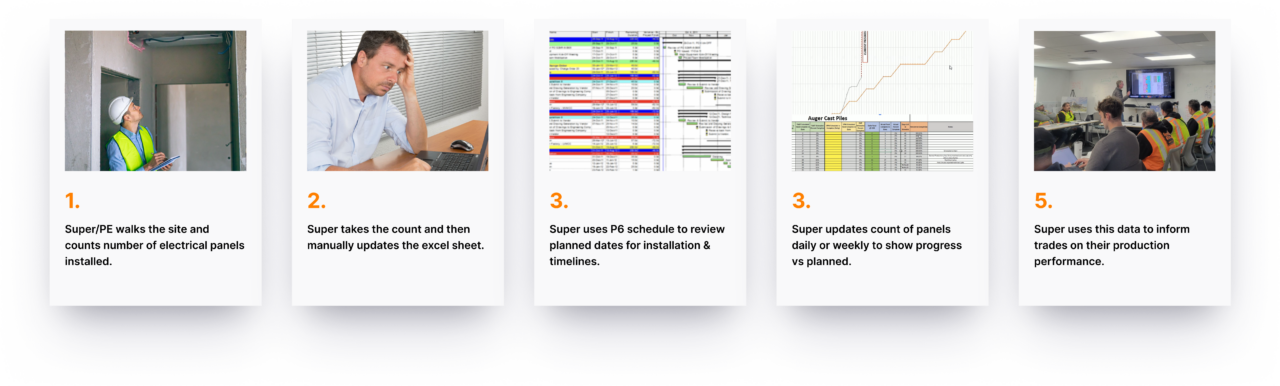
In major construction projects, the ability to plan, execute, and deliver on time and within budget is critical. However, one of the significant challenges many projects face is the lack of access to reliable production rates and the difficulty in creating accurate benchmarks. These data points are essential for informed decision-making, resource allocation, and performance tracking. Without them, project managers and teams often operate in the dark, leading to inefficiencies, cost overruns, and increased risk. The key challenges that arise when production rates are not readily available and benchmarks are insufficient, highlight the importance of overcoming these issues for project success. They include:
1. Inaccurate Project Estimations
2. Inefficient Resource Allocation
3. Poor Performance Tracking
4. Challenges in Continuous Improvement
5. Increased Risk and Uncertainty
Not having access to production rates and benchmarks in major construction projects can lead to a range of challenges, from inaccurate estimations to poor performance tracking and increased risk. Addressing these issues requires a concerted effort to gather, analyze, and utilize data effectively to create reliable benchmarks and optimize project outcomes.
Doxel is an automated progress tracking solution that provides real-time, objective data on construction performance. Unlike traditional methods that rely on manual tracking and subjective reporting, Doxel uses AI and computer vision to deliver frequent, precise, actionable insights. Doxel speeds up construction by automating progress reporting which surfaces hidden issues early, prevents rework, and enhancing collaboration with visual data.
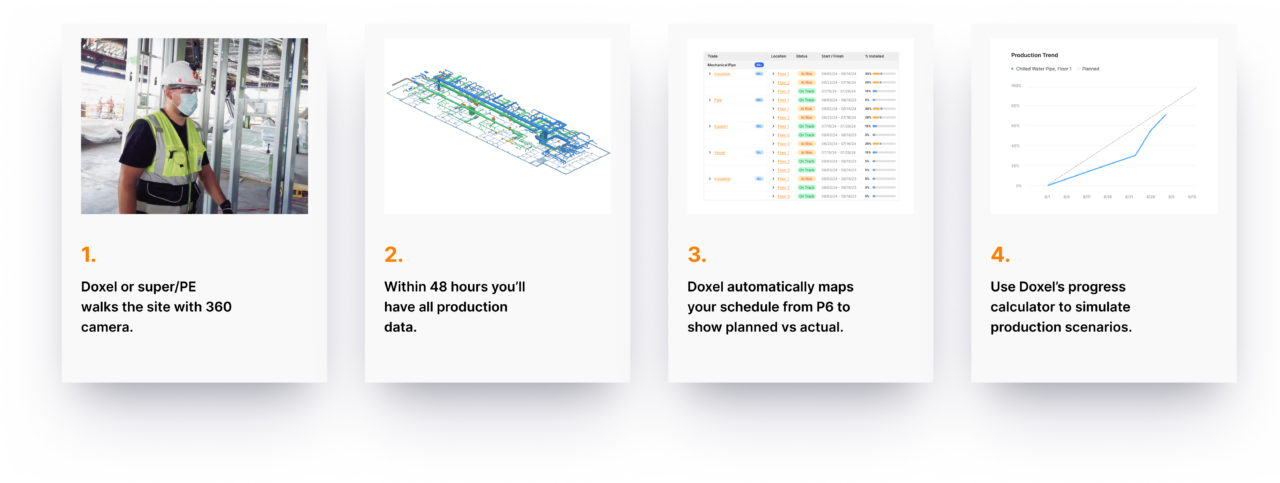
Doxel’s automated progress tracking leverages images from 360 degree cameras for reality capture by converting images into construction elements. This technology provides precise data on production rates, such as linear feet of conduit installed per week across multiple projects. By comparing this data across different trades, sites, and contractors, Doxel enables teams to create more realistic schedules based on actual performance metrics.
Owner’s reps, sometimes considered the Director of Construction, are responsible for fostering collaboration between stakeholders to bring data centers and large projects in on schedule and under budget. Consider a scenario where an owner has built multiple data centers using Doxel and has significant benchmark data on productivity rates for each stage in construction. This collaboration can provide enormous benefits when analyzing bids from the GC. Where project schedules are overly aggressive, project owners can challenge GCs on their ability to commit to accelerated schedules, fostering a sense of alignment. With Doxel’s historical production rate data, the GC can confidently assess the feasibility of the proposed schedule. The added transparency between the owner and GC, facilitated by Doxel, helps deliver projects on schedule using historical benchmark data.
Benchmarking: Use Historical Data to Set Realistic Schedules
Risk Reduction: Avoid Overcommitting and Mitigate the Risk of Delays
Informed Decision-Making: Make Data-Driven Decisions That Clients Trust
Enhanced Reputation: Deliver Projects on Time and Within Budget
In the construction industry, informed scheduling decisions are crucial for project success. Doxel’s production rate data provides insights to optimize schedules, reduce risks, and ensure successful project delivery. By leveraging this data, construction teams can confidently commit to achievable timelines and deliver exceptional results.
Ready to optimize your project schedules with Doxel’s production rate data? Contact us today for a demo and discover how Doxel can help your team achieve faster schedules with confidence and reduced risk.
By incorporating these insights and leveraging cutting-edge tools like Doxel, construction teams can navigate the complexities of project scheduling with greater certainty and efficiency.

With automated tracking, construction teams can ensure that 'almost done' quickly becomes 'completely done.
Let’s face it: Getting stuff done is hard. And getting stuff done in the face of today’s shortages, supply chain issues, and inflation is a daunting task for any construction company. Automated construction progress tracking can help you finish projects faster.
Before we get into that, let’s take a closer look at what’s going on.
Less people from younger generations are choosing a trade or apprenticeship. As a result, the industry is facing a shortage of skilled workers to help complete project milestones. Without knowing how many people can get the work done (and get it done correctly), companies struggle to stay on track.
Those who do choose to go into construction today are still green in their careers and don’t have the experience that seasoned employees do. This creates a learning curve and requires additional time needed to get them up to speed.
Unpredictable factors create unpredictable change—and change requires an added degree of flexibility for the project to adapt to the circumstances. As a result, companies are seeing more design changes come through, and the need to stay on top of assessing and documenting them.
Speaking of unpredictable, the industry ha seen an influx in supply chain issues, causing delays in shipments and—in some cases—a limited supply of the necessary materials available.
Across every industry, prices are going up. Companies must now reconcile their bids and project scopes to maintain profitability.
When the going gets tough, construction stays tougher. The industry is no stranger to uncertainty. Now more than ever, companies need to pinpoint areas of improvement and streamline their processes to maximize efficiency.
With all these factors weighing on a project’s productivity, the margin for error is very low—which means operational excellence is critical for success. Many projects get to a certain stage or near completion, but struggle to accurate assess what’s happening (or not) to get the rest of the way there.
Almost done isn’t done.
If the last 10% of a milestone takes more than 20% of the time—that’s a big, potentially costly, problem.
That’s where automated construction progress tracking comes in. With the right technology in place, companies can save 25% of superintendents’ and field teams time that would otherwise be spent on tracking progress and bringing everyone on the same page. That’s less time in meetings and back-and-forth conversations, more time building.
Real-time automated construction progress tracking gives everyone on a project visibility into the current state, without the need for individual communication. This ensures the project moves as quickly as it can and prevents trade stacking.
Stay on top of milestones with the ability to forecast and predict any slowdowns before they happen—instead of catching them after it’s too late. By automatically capturing more than 75 stages of construction, automated construction progress tracking technology can spot potential issues more efficiently in real time.
By providing accurate and automated cost budget analysis, companies are able to better understand their project and where it stands with the budget. When unforeseen factors or delays hit, you want all the knowledge and numbers you can get to properly adapt and minimize the impact.
In construction, communication can be slow and sparse. Automated construction progress tracking gets everyone on the same page without having to meet to discuss. Having a digital surveyor gives everyone the information and insights they need to collaborate faster—without relying on project resources to collect and report on it.
No matter what gets thrown at the construction industry, a company needs to be resilient and smart to see success on the other side. Companies who invest in the right tools that save time and automate processes have the advantage of receiving data and insights in real time. The faster something is flagged, the faster it can be fixed.
Want to learn how Scripps Health and McCarthy Building Companies are automating construction progress tracking to increase project visibility? Register for our upcoming webinar Almost Done, Isn’t Done.

Streamlining the process for creating detailed reports can free up the project team's focus while enhancing the level of reporting and insights for a company.
In a 2021 Workforce Survey Analysis, AGC found that 88% of companies surveyed were experiencing project delays—that’s nearly nine out of ten. Now more than ever, construction companies are faced with the challenge to do more with less and keep projects on track in the face of unforeseen circumstances.
While certain conditions and factors in the industry can’t be controlled, there are 3 construction workflows that can reduce the margin of error to ensure a project stays resilient. This requires operational excellence in the areas that can be predicted and made more efficient.
What are the three construction workflows a company should prioritize?
Communication among field teams, supervisors, and the office is crucial—and can be cumbersome. With so many moving pieces of a project happening at once, getting the necessary message out to everyone in a timely, effective manner is no easy feat.
Companies need to find a way to remove the barriers to communication. By doing so, they’ll save everyone on the project team valuable time that would otherwise be spent tracking progress, in meetings to get everyone up to speed, or playing telephone.
Quality of construction can make or break a project’s ability to stay on track. Quality issues or mistakes found too late in the process can be the kiss of death for moving onto the next phase—and as a result, teams remain stuck in the final 10 or 20% of completion for too long. This won’t just cost time and manpower, it’ll directly affect a project’s budget and profitability, too.
The only option to streamline and prevent these costly quality issues is to catch them early and address them quickly. Technology that helps companies see progress in real time opens the door for making smarter decisions and adapting faster.
When a project does make it through the final 10%, the work isn’t over yet. Teams must provide an objective, detailed overview of the completion—which again takes time and resources. There’s more information to gather, and no efficient way to compile it using manual efforts alone.
Teams should be focused on projects, not paperwork or reporting. Streamlining the process for creating detailed reports can free up their focus while enhancing the level of reporting and insights for a company.
By implementing a technology that can continuously monitor performance and provide predictive insights, construction companies are able to achieve operational excellence.
Platforms like Doxel act as a digital surveyor to automatically track progress across more than 75 different construction stages in real time, freeing up the project team’s time and resources.
Instead of manually walking the jobsite every day or week to capture exact progress, Doxel works with a 360° video to act as a digital surveyor in minutes. Combining the power of computer vision with BIM means companies have an objective truth of the status of a site—and can understand progress, schedule, and budget better than ever before.
If it sounds too good to be true, it isn’t.
Tune in to our webinar Almost Done, Isn’t Done to hear from two successful construction companies on how they’re leveraging real-time progress tracking to automate and achieve more.

By continuously tracking and analyzing construction site progress in real time, Production Rate Data serves as a single, reliable source of truth for measuring construction progress.
Traditionally, project managers have relied on site visits and progress reporting from their field teams to stay abreast of construction progress. On large capital projects like data centers, semiconductor wafer fabrication plants, or healthcare infrastructure this can become problematic where even small schedule delays lead to large cost overruns. Doxel’s Production Rate Data provides a solution that empowers project teams with additional data in order to monitor construction progress.

Production Rate Data is the information gathered through reality capture inputs (e.g., 360-degree imaging or drone footage), to continuously track and analyze construction site progress in real time. By comparing actual work completed against the planned schedule, this data serves as a single, reliable source of truth for measuring construction progress. It provides project owners with objective, accurate insights that are crucial for managing schedules and ensuring on-time project completion. This innovative approach equips teams with the data needed to identify delays, optimize workflows, and ensure efficient project delivery.
By leveraging this advanced technology, owner’s representatives can monitor projects with a data set they control, guaranteeing transparency and accuracy. Here’s how Doxel tracks completed construction:
Example: Mechanical Pipes and Walls

Doxel’s Production Rate tracking capability simplifies the comparison of completed construction against the schedule, offering a powerful tool for project owners to measure progress and manage schedules effectively.
Understanding how construction software tracks progress can be complex. Doxel simplifies this with a robust methodology:

Productivity is calculated using specific units of measure for each stage based on your work breakdown structure (WBS) in Primavera P6. For example, if the plumbing installation requires 100,000 linear feet of pipe, the unit of measure would be linear feet. The planned number would be 100,000, against which completed construction is measured.
As construction progresses, Doxel updates the number of completed activities. For instance, if only 20,000 linear feet of pipe have been installed for the drainage system, the 360-degree imaging would capture the work, and Doxel would update the percentage of completion for both the stage (drainage system) and the trade (plumbing) to 20%.
To help manage schedules effectively, Doxel introduced the Production Forecasting Calculator. This tool allows users to simulate different scenarios by adjusting crew sizes and production rates to forecast completion. General contractors can manage subcontractors to ensure they stay on schedule. At the same time, owner’s reps can monitor production rates remotely, gaining confidence that construction progress is on track based on actual data.
Production Rate Data compares completed construction against your schedule, providing a single source of truth for measuring construction progress. Doxel’s system allows you to manage productivity for each stage of the construction project by trade, zone, and floor. This capability empowers project owners with a controlled data set that facilitates better communication with general contractors and helps address potential schedule delays proactively.
By giving project owners control of the data, Doxel ensures a higher level of transparency and efficiency in construction management. This innovative approach enhances collaboration and significantly reduces the risk of delays, optimizing time and resources. With Doxel’s Production Rate Data, project owners can confidently steer their projects to successful completion.

Accurate and reliable progress tracking is essential for effective communication and coordination, especially with multiple stakeholders and a higher level of complexity. Automated construction progress tracking can meet these requirements and reduce manual effort, helping you complete your projects faster and on-budget.
Healthcare construction is more complex and has a lot at stake. If not done right, these projects can be costly for everyone involved. Healthcare projects also require a higher attention to detail to keep everything running smoothly.
With more stakeholders involved in the process, companies need to be able to benchmark and be equipped for better prediction, transparency, and ultimately the ability to detect (and curb) problems, deviations, and cost overruns.
Automated progress tracking can meet these requirements and reduce manual effort, helping you complete your projects faster and on-budget.
Progress tracking is critical for project success in healthcare because it allows for real-time monitoring of project performance and a faster identification of issues and challenges, and implementation of corrective actions.
By regularly monitoring progress and performance, project managers and teams can quickly identify areas that are falling behind schedule or budget—and take the necessary steps to address them before they become major issues. Accurate and reliable progress tracking is essential for effective communication and coordination, especially with multiple stakeholders and a higher level of complexity.
Progress tracking can be beneficial beyond one single project, too. Objective progress data and insights can also help to identify areas of success and best practices that can be replicated in other projects, improving overall project performance and company-wide outcomes.
Automated progress tracking can improve transparency during hospital construction by providing real-time, accurate information on the progress of the project. Automated systems can be configured to collect data from a variety of sources, create a single source of truth and present the information in a format that is easy to understand and always accessible.
With the enhanced, real-time visibility that automated progress tracking brings, stakeholders are able to see exactly where the project is at any given time. This clear picture of project status helps improve communication, transparency, and accountability with objective data that eliminate any debate in progress tracking.
Automated progress tracking is a faster way of providing stakeholders with access to the same information. With an automated system, stakeholders are able to see the same data and reports, regardless of their location. Ensuring everyone is working with the same information saves time in reporting and mitigates the possibility of miscommunication or misunderstanding.
Since hospital construction projects often involve large sums of money and have a significant impact on patient outcomes, it’s also useful to have an auditable record of each project’s progress that can be used in demonstrating accountability to funders and regulatory bodies.
Healthcare construction projects need an efficient way to manage and mitigate risk. Proper real-time visibility into the progress of the project can help spot potential issues before they become major problems. This enables project managers and other stakeholders to take proactive measures, rather than waiting until it is too late to take corrective action.
For example, if progress tracking reveals a particular aspect of the project is running behind schedule, the project manager may be able to adjust the project plan to effectively avoid potential delays or cost overruns.
Additionally, progress tracking can help project managers manage and coordinate dependencies between different parts of the project, which further reduces the risk of delay, prevents trade stacking, and mitigates other issues arising from one part of the project impacting others.
Progress tracking can help with benchmarking by providing a clear understanding of the current status of the project, including the status of all trade and any related delays or setbacks. This data can then be used to compare the project’s progress against similar projects or industry standards, making it easier to identify areas where improvements can be made.
With multiple sources of information on a single project, a digital progress tracking tool can deliver accurate data to one shared source of truth, making benchmarking markedly easier.
Additionally, progress tracking stored data can be leveraged for benchmarking future progress against previous internal projects for better forecasting future project and completion dates, as well as for identifying potential cost savings or other opportunities to optimize the project.
The more detailed information teams have on the progress of a project, the more proactive they can be to keep it on track. Identifying potential issues early on allows for corrective action to be taken sooner rather than later, reducing hours, rework, and delays to deliver projects on time and on budget. But detailed and timely progress tracking shouldn’t come at the cost of crews’ time and resources.
That’s where a solution like Doxel’s automated progress tracking can help. Doxel significantly reduces hours tracking progress, while delivering accurate, reliable objective insights that improve communication and transparency across all stakeholders.
Click here to learn more about how Doxel’s AI-powered progress tracking paired with 360-degree video capture can help ensure hospital construction projects stay on track and on budget.

Healthcare construction teams that leverage AI-powered performance monitoring are armed with accurate data in near real-time to keep projects on track.
Healthcare construction is a specialized niche in the industry, and the projects within it require a high standard of attention to detail to meet their deadlines. These projects are complex and involve the coordination of large, cross-functional teams to complete them on tight schedules—which means a project’s success is majorly dependent on the efficiency and collaboration of the team building it.
Every day that the facility is delayed or past schedule means another day patients can’t come in, and the owner or company will lose money.
Enter, AI-powered project controls – automated construction progress tracking.
The construction of healthcare projects is a delicate balance of innovation and realism. As one of the more technology-driven sectors, these facilities aim to have the latest and greatest equipment, but at the same time needs to be planned months in advance and available within a certain deadline. Teams must stay on top of an ever-changing landscape and varying demands—so having accurate, objective project progress data throughout is essential.
One of the biggest factors to staying on schedule is knowing exactly where you are. Without a single view of project progress, sticking to a set schedule becomes a risky guessing game. Progress tracking using the power of computer vision enables project teams to build faster and more accurately together.
After all, knowledge is power. Teams that leverage AI-powered performance monitoring are armed with accurate data in near real time to see backwards at what’s been done, as well as ahead at predictive insights.
Rework can be a project schedule’s worst nightmare—and the later it’s caught the bigger a scheduling headache you have on your hands. Rework takes valuable time away from what should be forward progress. In order to achieve schedule predictability, a project team has to be able to spot (and avoid) potential rework on the critical path.
Using computer vision automated construction progress tracking that acts as a digital surveyor, superintendents can quickly catch any missing or incorrectly installed components before the next trade covers up the error. This foresight can help avoid weeks of delays and schedule compression, which ultimately helps the facility stay on track to open on time or earlier.
Real-time automated construction progress tracking doesn’t just help with new healthcare construction—it can also help reduce downtime during facility operations down the road.
Picture it (if you dare): A construction company closes off an area to cut into the wall and fix MEP services only to discover that it wasn’t installed per as-built plans. Instead of adhering to the plan, dreaded rework is now required.
But what if you had x-ray vision instead? Comprehensive reality capture of an as-built facility ensures maintenance teams know exactly what was installed and where, so any maintenance and retrofits can be done efficiently without the rework. Instead of costing days of downtime, teams can get in and get it done as planned the first time.
At its core, Doxel is automated construction progress tracking that provides objective, accurate data on materials installed for real-time project controls. The more teams can document in the moment, the more productive and proactive they become.
Find out how healthcare projects have used Doxel to deliver facilities earlier and at a higher standard of quality.

Putting the model in the hands of field teams every step of the way gives them immediate access to see where their efforts line up (or don’t) for the project.
Ever since the pandemic, QR codes have had a resurgence in society. When the world turned contactless, restaurants and businesses began leveraging QR codes for menus and signage. These small codes have since become a go-to for pulling up web pages quickly and conveniently.
As QR codes continue to become more prevalent, other industries have taken note and discovered ways to leverage them—and construction is no exception.
But before we get into that, let’s cover some basics.

The ‘QR’ in QR codes stands for Quick Response, which makes sense when you think about the way they work. By pointing a device’s camera at the code, a destination link is pulled up and can be accessed instantaneously.
While they may have become most popular after 2020, these codes are not a new technology. QR codes were first created in 1994 by the Japanese company and Toyota subsidiary Denso Wave as a more accurate way to track vehicles and parts during the manufacturing process. The original intention behind QR codes was to reinvent the barcode by making something that was easy to scan and could hold more data than the average barcode.
In a time where businesses needed to (and continue to) adapt, QR codes and smartphones have become a powerful duo to further streamline access to information.
It’s no secret the construction industry is facing some challenges. From labor shortages to supply chain, the circumstances have further shown the importance of operational excellence on a project. To help combat these challenges, maintain a high standard of execution, and minimize risks of mistakes, many construction companies have found technology to be the answer.
Can QR codes play a part in this? In our webinar Almost Done Isn’t Done, one Doxel customer shared his team’s innovative way of incorporating QR codes around the job site to bring everyone on the same page, faster.
By strategically placing QR codes around key points of the job site, all the contractors for the project are able to instantly access the corresponding models and plans needed. That way, when the contractor is getting ready for the install or build, they can simply scan the QR code to confirm what they need to accomplish.
Putting the model in the hands of field teams every step of the way gives them immediate access to see where their efforts line up (or don’t) for the project. This makes it easy to ensure accuracy while progress is being made versus waiting until it’s too late.
How do companies make their own custom QR codes? Here’s a handful of solutions to consider:
While this technology is helpful enough on its own, the destination of the QR code is what can really make the difference on a project’s path to operational excellence.
Let’s talk about what happens when laser scanning and real-time progress tracking join the party.
Doxel’s AI-powered tool automatically maps and overlays 360-degree video to the BIM and 3D models. The split view allows teams to quickly understand what’s in progress and what’s done, along with the quality of installed systems.
Site progress is automatically quantified and visualized and can be differentiated by trade to compare what’s there to what should be—and as a result everyone is objectively aligned on true progress.
Imagine all this at the touch of a button, a scan of a code. With the convenient access of QR codes connected directly to Doxel, field teams can better (and more instantly) answer two of a project’s biggest questions:
Are things where they are supposed to be?
Are we on schedule?
By having the color-coded, easy to understand analysis of progress just a QR code scan away, project teams can be more proactive and accurate in their work.
If you’re ready to take your project models to another level, schedule a demo of Doxel today.

Work In Progress reports provide accurate progress data that project teams can trust across the entire site.
Construction is a unique industry in many ways, one of which being the flow of cash and accounting process for projects. Whereas many industries have straightforward transactions and payments, construction costs tend to be more complex and nuanced—which makes it more difficult to stay on top of a budget with money constantly going out and coming in.
From estimation and bidding to delays and change orders, there are many stages and factors that go into determining the cost (and profits) of a project.
How can companies know if they’re on schedule and under budget before the project closes? Work in progress is the answer.
A work in progress (or, WIP) schedule is a detailed report that shows the percentage of progress completed on a project—and takes into account any work that’s in progress in relation to budget and profitability. Below are four reasons WIP Reporting is essential on every project!
When it comes to a project’s progress, communication is critical. Without clear, real-time communication, project teams waste valuable time meeting to discuss and determine where a project stands. Progress can also be misrepresented or miscalculated, which directly impacts the budget and schedule of a project. With so many moving parts to balance, construction companies can’t afford to make mistakes due to miscommunication.
WIP reports provide accurate progress data that project teams can trust across the entire site. This reduces any subjectivity throughout the building process and gives everyone one source of truth to work from.
Many contractors choose to implement progress payments, which means the project is billed based on certain percentages of completion as they’re reached instead of waiting until the end of a job. Combine progress payments with inaccurate progress reporting, and the project can very quickly become overbilled (revenue billed exceeds the work completed) or underbilled (work completed exceeds what’s been billed).
WIP tracking provides the exact progress percentage of work completed to create a shared understanding and accountability for project costs accrued so far—and can help shed light on any discrepancies in the budget to prevent future cash-flow problems. This is especially helpful for those project managers who like to ‘guesstimate’ based on a gut feeling, then try to do the math later to even it out.
Hindsight may be 20/20, but it won’t keep your project profitable. A problem is much harder to fix after it’s already happened. While discussing what went wrong at the end may help your next project, the power to be able to notice and act in real time is invaluable. Project teams need to be able to spot potential problems as early as humanly possible to minimize the impact and keep everything on track.
That’s where work in progress tracking comes in—it’s in the name. Using technology that quantifies progress all the way down to the subcomponent level allows stakeholders to catch an issue and course correct as soon as (if not before) it happens. This prevents mistakes from becoming costly and provides insight for better business decisions in the future.
While catching issues early on is one thing, being able to predict a project’s future is another. With the right AI-powered progress tracking, companies can track project performance for deviations from plan and forecast a more accurate estimate at completion.
Knowing where your project is heading before you get there means you can plan accordingly and get ahead of costly trends. WIP tracking data gives project teams the ability to confidently manage the schedule and predict delays.
At the end of the day, work in progress reports give a true and accurate view of the financial health of a project. However, they require accurate project progress data to be effective.
Companies that leverage technology with AI-powered progress tracking can truly reap the benefits of WIP reports—and ultimately keep their projects on track and profitable.

By letting the AI automatically analyze visual data, construction companies are able to measure installed quantities and inspect quality—without having to sift through data or manually record the entire jobsite.
Construction—an industry that’s been around for nearly as long as civilization—is long overdue for a change in the tools used to build the world. While technology has become more and more common on a jobsite, most of it has been focused on taking companies from pen and paper to digital data and drawings. This is a step forward, but still requires a significant amount of manual effort and calculations to be effective. One tool alone may not completely transform an industry, but the right technology in combination could unlock the secret to more profitable and productive projects. That’s where machine learning comes in.
When you hear the term “machine learning” or “AI” (artificial intelligence), your mind probably goes straight to what you’ve seen in movies and television. While there isn’t a terminator on a jobsite (yet), construction companies are beginning to leverage an entirely new generation of technology to further reduce manual effort and increase visibility and insights.
A lot of the existing construction technology leverages visualization software to overlay captured data onto a 3D design. While this helps add an extra layer of visibility, it won’t tell you much more about true progress without someone having to look through every photo and laser scan. When given the choice, most jobsite managers would rather walk around and measure progress manually than spend even more hours doing it on the computer.
Computer vision-based progress tracking takes it one step further. By letting the AI automatically analyze visual data, construction companies are able to measure installed quantities and inspect quality—without having to sift through data or manually record the entire jobsite. What used to take someone hours is now an automated, real-time progress and quality report they can access anytime.
Imagine being able to automatically track more than 75 different construction stages and generate progress, down to the materials installed, and all it takes is a 360° camera, BIM, and AI-powered platform.
This automated progress tracking isn’t just for the project teams. Traditionally, if an owner wants a project update, they either have to physically come to the jobsite or rely on the reporting of project managers and subcontractors. This reporting takes valuable time, and is often incomplete and delayed (or missing entirely) depending on how busy the team is.
AI platforms take the burden off of project teams by enabling them to capture more detailed data, faster. Artificial intelligence can essentially act as a digital surveyor to capture hundreds of thousands of square feet on a project every week—freeing field crews up to focus on making progress, not reporting on it. Those uncomfortable OAC and weekly trade coordination meetings where progress isn’t clearly measured or communicated can quickly become a thing of the past.
Real-time project visibility allows companies to spot potential issues or overruns faster, and gives them enough time to make changes before it’s too late.
In construction, the four biggest factors to a project’s success are time, money, quality, and productivity. The right balance of these factors could mean the difference between coming in on time, under budget and losing money on a project. The increased visibility and reporting that AI-based software gives managers can directly translate to real-time feedback on schedule, budget, and quality.
Machine learning provides companies objective schedule and cost budget analysis to ensure everything is progressing to plan, and can prevent costly rework or delays. It isn’t enough to be able to see what’s happening as it happens—companies need to be able to look into the future of a project using predictive forecasts, too (another AI specialty).
Real-time feedback and insights have the power to take construction companies to a new level of project success. Machine learning isn’t about replacing people with machines. It’s about leveraging automated, artificial intelligence to increase productivity and visibility so teams can make better business decisions, faster.

Achieving success in healthcare construction projects requires a focus on transparency, risk management, and benchmarking. By leveraging near real-time data and advanced technology, stakeholders can ensure project efficiency, mitigate risks, and deliver high-quality outcomes within expected timelines.
Healthcare projects are not typical commercial construction. Aside from the complexity and cost, healthcare carries a higher level of risk and liability with patient care depending on the outcome of the project. With more at stake, accuracy and predictable outcomes are paramount to the success of the project.
At the foundation, there are three pillars to success for any healthcare project: transparency, risk management, and benchmarking.
Let’s take a look at each of these pillars—and at how automated progress tracking can help companies meet these requirements to help teams complete projects on time and under budget.
Transparency between owners, general contractors, and subcontractors is critical in hospital construction because it ensures every step of the way that the project is following the schedule, budget, and required quality standards.
Clear communication and the sharing of real-time information makes it easier to identify and resolve any issues that may arise during the construction process, which can prevent delays and cost overruns.
Additionally, proper transparency makes sure all parties are working towards the same goals and that everyone is aware of the project’s progress and any necessary changes. In the case of hospital construction, it’s important that transparency is maintained to ensure the safety and well-being of the patients, staff, and visitors—both during construction and after it’s completed.
How can construction companies improve transparency among all stakeholders? Here are five processes that can help.
Due to the costs and complexity of healthcare projects, it is crucial to mitigate risk to ensure safety, quality, and compliance. Risk is inevitable in construction, but there are steps you can take to reduce and ensure better outcomes for your projects.
By following these steps, healthcare construction projects can manage risk and improve outcomes. Even better, there’s technology that alleviates the manual component to many (if not all) of the steps needed to mitigate risk.
By pairing 360-degree video capture with AI-powered progress tracking, teams are able to objectively measure progress of work in place with every data capture, every week. This provides healthcare construction projects with real-time information on the progress and quality of what’s been completed.
Automated progress tracking is the best way to bridge everything together to keep project teams on the same page and catch potential issues faster with enough time to fix them—ultimately preventing delays and unnecessary overruns. This greater degree of transparency and accountability helps to ensure that all parties are meeting their obligations and building to the required standard of the project.
Benchmarking in healthcare construction provides a way to measure and compare the performance of different projects. Leveraging benchmarks helps to identify best practices and areas for improvement, which can be used to set goals and targets for future projects. Benchmarking can also reveal trends and patterns across projects to identify any potential risks and opportunities earlier on.
Healthcare construction benchmarking can inform decision making and contribute to the success or failure of a project. For benchmarking to be most impactful, project progress should be collected in a standardized and repeatable way. Implementing an automated way to analyze project progress in real time helps save time and ensure meaningful insights—ultimately leading to more predictable outcomes, as well as improved quality, cost, and schedule performance.
Automated progress tracking works to streamline the three pillars for project success by providing objective information and greater visibility into the project’s progress. Between project teams and stakeholders, everyone is able to be more closely involved to make more informed decisions faster.
With all parties working towards the same goals, everyone is aware of the objective progress metrics as well as any changes needed. With the right solution in place, teams can increase efficiency, decrease risk, and save valuable time and resources.
Not sure where to get started? Click here to learn more about Doxel’s digital surveyor and analytic tools for healthcare construction today.

Ezra Klein rings the alarm that the $1.6 trillion U.S. construction industry has not shared the productivity gains of other industries. After two decades into a career focused on bringing productivity gains to construction, Reid Senescu, Vice President of Product at Doxel.ai has an idea that can alter this trend.
In his February 5, 2023 opinion piece in the New York Times, Ezra Klein rings the alarm that the $1.6 trillion U.S. construction industry has not shared the productivity gains of other industries. He cites Goolsbee and Syverson’s paper “The Strange and Awful Path of Productivity in the US Construction Sector,” which explains that construction productivity has decreased since 1950 while manufacturing productivity, for example, has increased ninefold. I appreciate Mr. Klein’s alarm as well as his humility in admitting he has no idea how we get construction productivity rising again. Two decades into a career focused on bringing productivity gains to construction, I do have an idea.

But before I get to my idea, let’s consider Mr. Klein’s prime culprit – regulatory “paperwork, and paperwork, and more paperwork.” No doubt regulation impacts construction productivity; regulation impacts most industries. While Syverson’s paper does not provide data connecting productivity declines to increased regulation, it does note that the construction industry invested 46 percent less in R&D and software purchases compared to the broader economy in 2020. And, a separate paper by Syverson, “The Slowdown in Manufacturing Productivity Growth,” (my fellow construction colleagues will take solace in knowing we are not alone in facing Syverson’s economic scrutiny) explains that information technologies (IT) were the main driver for productivity gains in manufacturing from 1994 to 2005.
Why did IT so dramatically impact manufacturing, but not construction? In both construction and manufacturing, IT can improve productivity once information about the real world is transformed into data. Consider an assembly line producing widgets. The assembly line has sensors that send data to machines to respond in real time and to plant managers who learn of bottlenecks and continuously improve the assembly line. This investment in sensors produces the data that powers IT and drives productivity increases.
Applying IT to construction is not so easy. While a factory produces millions of widgets, a construction project is the assembly of millions of different components to produce only a single facility. A single sensor cannot automatically monitor the installation of thousands of square feet of walls or linear feet of ductwork. And that limitation means that IT is starved of data that would help construction workers and managers gain insights to continuously improve their processes. Thus, until recently, investment in IT has been limited to the design phase and certain aspects of construction administration. Yet, labor is the greatest cost on any project in the U.S. And, IT has had virtually no impact on the productivity of that skilled craftworker laying a brick or welding a beam to a column.

But, that reality is changing. With artificial intelligence (AI) and computer vision, leading builders are transforming 360 video into near real-time measurements of construction processes. This near real-time reality capture of the construction site acts like sensors in a factory, feeding IT with data that empowers project teams to increase productivity. For example, a construction superintendent constructing a retirement community recently used this automated progress tracking technology to identify that a certain duct installation activity was not yet complete on the 3rd floor. Ceilings were set to be installed the next day. Without this insight from technology, the unfinished ductwork would have been covered up by the ceiling trade partner. And, when they later discovered the oversight, they would have had to rip open the ceiling. That rework would have put a big dent in their productivity. Instead, the AI-powered IT indicated the ductwork was not 100% complete. Augmented with this information, the superintendent applied his expertise in coordinating trades to get the ducts installed right away to avoid the rework. And, the general contractor and retirement community owner no longer had to explain to residents why they were going to be moving in two weeks late.
This technology is new; we only began building it in 2015. But we’re seeing results. At Doxel, we’ve created automated progress tracking for construction that reduces time spent manually tracking progress by 95%. This automation creates data that is now fueling productivity gains from IT just like in manufacturing. And, it gets data to decision makers 5x – 10x faster, which gives 5x – 10x the opportunities to unlock the full potential of construction teams to accelerate schedules and deliver projects under budget. We’re not alone in augmenting construction team expertise with AI; companies such as Procore, Autodesk, Oracle, Dusty, Rhumbix and dozens of others have built technology that makes construction easier for millions of workers every day. And, forward looking facility owners are hungry to adopt solutions that reduce their risk and make the job easier for superintendents and trade partners, because they know the investment will translate to projects that are on time and on budget.
Of course, an industry’s health depends on more than a single metric. Construction provides nearly 11 million jobs in the U.S., including many high paying roles that do not require a college degree. They are rewarding jobs that contribute to society. But, the work is not easy. It frequently requires complex problem solving or complex physical skills. These are great jobs, partially because they can’t be easily automated to increase productivity. Still, productivity is an important metric not just for economists, but because it tends to correlate with the industry’s per capita income. According to Syverson, construction pay could be 10% higher if the industry’s productivity gains tracked the economy as a whole. Society needs construction to be easier, too. As we face challenges supplying healthcare, delivering energy, and investing in infrastructure, construction will either be a bottleneck to change or it will be a catalyst to change. AI augments the experience and skills of construction teams, so they have better data and tools and owners have the confidence to invest in projects that solve society’s 21st Century challenges.
Written by Reid Senescu, California Licensed Professional Engineer and PhD in Civil and Environmental Engineering from Stanford University. He is the Vice President of Product at Doxel.ai in Menlo Park, California. His research focused on how technology can improve construction team collaboration. At Doxel.ai, his products use computer vision to help teams collaborate and deliver projects on time and on budget.

Doxel’s AI technology enables Oracle’s customers to have real-time, objective visibility into their schedule performance
Doxel, an AI-based construction technology solution that enables proactive risk mitigation of projects and portfolios, announced its integration with Oracle’s Primavera P6 Enterprise Project Portfolio Management (EPPM), the solution for globally prioritizing, planning, managing, and executing projects, programs, and portfolios.
The Doxel and Oracle integration will enable customers to track construction progress continuously and automatically against their Oracle Primavera P6 schedules. Unlike manual methods of progress reporting that can be subjective or delayed, Doxel’s AI technology enables Oracle’s customers always to have real-time, objective visibility into their schedule performance.
Proactive mitigation of delays and identification of opportunities to accelerate construction—enabling customers to deliver their projects faster while collecting valuable benchmark data for future planning in Oracle Primavera P6 EPPM.
“This integration with Primavera P6 is by popular demand from our mutual customers, and we couldn’t be more excited,” says Saurabh Ladha, chief executive officer of Doxel. “Nearly 100% of our customers use Primavera P6 for scheduling, and this unification of workflows will supercharge our customers’ abilities to manage their projects and portfolios proactively.”
Doxel, based in Menlo Park, California, has built a widely adopted platform that applies AI and computer vision technology to 360-degree video of construction sites and measures progress in a granular, real-time, and automated fashion, and then contextualizes actual progress against Primavera P6 EPPM plans.
Through Doxel’s cloud-based dashboard, customers can instantly see where they’re ahead and behind, informing their decisions with data that can always be trusted and delivered in time for proactive actions that ultimately land projects on schedule and budget.
“We see project teams use Doxel AI and Primavera P6 side by side in construction trailers. P6 is an amazingly powerful scheduling and planning tool and requires information from the field that can accurately, objectively, and with higher frequency measure and constantly update progress. Because if you don’t have high-quality data feeding into it, its value diminishes exponentially,” says Garrick Ballantine, Doxel’s chief revenue officer.
He adds, “General contractors and owners use the combination of P6 and Doxel to objectively partner with their trade partners on a week-to-week basis, bringing the field and office on the same page with our cloud-based visual dashboard and to make payment decisions on billions of dollars’ worth of construction nationally. This integration has happened because the industry demanded it.”
Frank Malangone, Oracle’s executive director of innovation and industry strategy, said, “Our customers continue to look for ways to objectively and accurately measure progress to update the schedule for reliable insights. This connection between Primavera P6 and Doxel speeds up this process without constantly having to be at the job site and improves communication and coordination between the office and the field.”
This article original appeared on Oracle’s blog.

By providing accurate and automated cost budget analysis, companies are able to better understand their project and where it stands against the budget.
With inflation and rising cost of materials, it’s critical for healthcare companies to keep construction projects on schedule and within budget. Here are 4 ways to help verify your construction billing and keep your project on budget.
Automated construction progress tracking provides an objective view into exactly where the project stands, which can help mitigate contractors overbilling for a higher percentage of completion. Companies that use a single source of truth for progress tracking (like Doxel) can reduce monthly bills by up to 10%.
With money still left on the table, contractors will be more motivated to finish the job so they can get paid.
Change orders are inevitable—but transparency around them should be, too. Before a major healthcare provider started working with Doxel, they estimated 4% of their total spend was caused by inaccurate progress tracking. These additional COs are passed onto the healthcare company, and are avoidable with the right solution in place.
Leveraging AI-powered progress tracking takes the mystery out of CO estimates. While using Doxel, one healthcare company found their typical change order estimates were inflated by at least 10%. That money is going out the door, and eventually it will add up. With more accurate project tracking, companies can more accurately pinpoint where change orders should be and reduce unnecessary spend.
Due to the unpredictability of material requirements, HealthTrust Contracts run the risk of being underutilized, and healthcare companies miss out on potential rebates and discounts offered. Doxel helps drive 100% contract utilization with more accurate, objective, and standardized measurement of materials installed across projects—which in turn allows more materials purchased through HealthTrust and greater financial savings.
For one Doxel healthcare customer, that meant the ability to purchase 10% more through HealthTrust, and the savings added up to a whopping $18.56M annually through discounts and rebates on materials.
Time is money. When a project’s progress is manually tracked, the process itself to collect and report on the data takes valuable time away from contractors and field teams. What used to take 60+ hours of manpower a week to manually assess progress now takes a mere 3 hours per week using an automated solution like Doxel. All that time can now be focused on safety, quality control, and coordination of trade partners.
See why healthcare companies (and contractors) choose Doxel
Doxel’s image recognition gives healthcare facilities objective progress data and real-time insight into materials installed. With automated project tracking, everyone wins—contractors spend less time counting and reporting, and healthcare companies have better control over project costs and governance.
Healthcare facilities using Doxel are delivered earlier with increased safety, less expense, and higher quality. To learn more about how they do it, schedule a demo today.

Finding remaining work can feel like finding a needle in a haystack, but Doxel makes it straightforward.
Identifying what’s still pending can feel like finding a needle in a haystack, especially when less than 10% of a particular trade’s work remains. Doxel has updated the Work In Place visualization to make it easier to find remaining work.
Managing a large construction project involves ensuring that millions of components are installed correctly, in the correct sequence, across many trade partners. Put simply, it’s easy to see what is there, it’s hard to find something missing. As more trades begin their installations, the not installed scope gets occluded, making it hard to visually see what’s left. This leads to a common problem in construction: unfinished in-wall MEP (Mechanical, Electrical, and Plumbing) being covered up by drywall teams, leading to costly and demoralizing rework.
Choosing “Not Complete” in Doxel’s Work in Place visualization is a straightforward approach to solving the challenge of finding remaining work. By isolating the components that are yet to be completed, Doxel enables teams to have focused conversations with trade partners and other responsible parties. This feature empowers site teams to:
The Work In Place visualization helps site teams easily manage and track work installed by providing an automated, color coded 3D model of the structure, broken down by trade, zones, and stages of construction. Now you can select a trade, sort by “Not Complete” and see what is yet to be installed for that trade. This powerful tool answers the critical questions: “What is installed?’, “What is pending?” and “What is not done?” so that construction teams can appropriately manage labor, sequence trades, and hit project milestones.
%2520(3).gif)
Traditional construction progress tracking methods rely heavily on manual inspections and subjective reporting, often leading to errors and oversights. With the size and complexity of construction, it is simply too time-consuming and error-prone to accurately count each hanger, pipe, or panel.
Visualizing work in place allows teams to quickly identify remaining work and understand the reasons behind any delays. By sorting by “Not Complete,” superintendents and trades can better coordinate with each other, quickly identifying where they should be working next or identifying missing work. This improved clarity helps teams verify that all tasks are completed, understand their next steps, and ensure that all work is done in the correct sequence.
Additionally, knowing what is left to do is crucial for commissioning and inspection sign-offs. Failing to identify unfinished work can delay these critical milestones, impacting the overall project timeline. By using Doxel’s Work In Place visualization, teams can ensure that all necessary work is completed and ready for inspection, preventing delays and ensuring a smooth progression towards project completion.
Construction is complex and details matter. Doxel’s Work In Place visualization helps teams find the right information quickly. By providing a clear and accurate view of unfinished work, Doxel empowers teams to prevent costly oversights, improve efficiency, and enhance collaboration.


