

.png)



Doxel is heading to DCAC Europe 2026 on June 23–24 at The Roundhouse in London. See us on "The Balcony" during the event on June 24.
Known as “The People’s Conference,” DCAC Europe has become one of the most respected operator and builder-focused gatherings in the data center industry. The event brings together owners, operators, engineers, contractors, and delivery leaders for candid discussions around the realities of building critical infrastructure at scale.
Unlike larger corporate trade shows, DCAC Europe is intentionally designed around community, practical conversations, and operational insight. The event consistently attracts the people directly responsible for solving some of the industry’s most challenging problems.
“We are in the middle of the fastest industrial shift in human history — the 5th Industrial Revolution. AI, compute, power, labor, land, capital, and community trust are colliding in real time, yet the world still fundamentally misunderstands the sector making it all possible.
Data centers are not background infrastructure. They are the front line of the AI era. That disconnect is no longer just frustrating. It is actively dangerous.
Misconceptions around our industry are slowing workforce development, delaying policy clarity, impacting community trust, and creating friction across project execution and capital deployment. This year, DCAC is focused on confronting that narrative head-on.” - DCAC Team
DCAC Europe brings together the people responsible for building and operating some of the world’s most complex data center projects.
That is why Doxel continues to attend year after year.
The event creates valuable opportunities to connect directly with teams focused on improving construction performance, increasing schedule certainty, reducing risk, and delivering projects faster with greater predictability.
Doxel helps owners and contractors gain objective visibility and actionable insights into construction progress through AI-powered progress tracking. By comparing field conditions against BIM models and schedules, teams can identify risk earlier, improve coordination across trades, and make faster, more informed decisions.
Instead of relying on subjective updates or delayed reporting, project teams gain measurable visibility into actual production progress across the jobsite. This allows teams to understand what is truly complete, what is falling behind plan, and where intervention may be needed before delays compound.
On major projects, Doxel has helped teams move beyond subjective “rule of thumb” tracking toward objective production benchmarking and real-time operational insight.
This level of visibility becomes increasingly important on fast-moving data center projects where even small coordination issues can create cascading schedule impacts across multiple trades and work areas.

Representing Doxel at the event includes Faiz Alidina, Director of Sales, EMEA, Ken Denning, David Brody, Hamza Abukar, and Dom Pound-Palmieri.
Doxel will also participate in the networking and community events surrounding DCAC Europe, including the DCAC Charity Golf event on June 23 at Sudbury Golf Club.
If you are attending DCAC Europe 2026, connect with Doxel to learn how leading data center teams are improving visibility, predictability, and execution certainty across complex construction programs.
Event website: DCAC Europe 2026
From June 2–4, Doxel will join thousands of leaders across the global data center ecosystem at the 2026 Datacloud Global Congress (DGC) 2026 in Cannes, France.
Held at the iconic Palais des Festivals et des Congrès, Datacloud Cannes brings together hyperscalers, developers, investors, operators, and construction leaders shaping the future of AI infrastructure and digital capacity expansion.
With more than 6,000 attendees expected, this year’s event arrives at a critical moment for the industry. AI demand continues to accelerate the construction of data centers globally, while labor shortages, power constraints, and schedule pressures continue to intensify.
As a Silver Sponsor, Doxel will be exhibiting at Booth #317 with full EMEA sales, product, and customer coverage on site, including participation in the event’s pre-conference cycling activities.
The conversations at DGC align directly with the challenges Doxel helps solve every day on large-scale projects.
Across the industry, owners and builders face mounting pressure to deliver complex facilities faster while maintaining quality and reducing risk. At the same time, construction productivity continues to lag behind other industries despite increasing project complexity and demand. For data center teams building hyperscale campuses and AI infrastructure, delays and missed coordination windows can quickly create cascading schedule impacts.
That is why objective, real-time construction visibility has become increasingly important.
Throughout Cannes, Doxel will showcase how leading owners and contractors are using AI-powered progress tracking to improve schedule certainty, benchmark production, and reduce costly surprises in the field.
Doxel automatically captures and analyzes site progress against BIM models and schedules, giving teams real-time visibility into what is actually happening on site. The platform eliminates the delays and inconsistencies that come from manual reporting and subjective progress tracking.
On major projects, Doxel has helped teams move beyond “rule of thumb” project management by introducing objective production benchmarking and real-time performance insights. DPR Construction used Doxel to improve benchmarking consistency and increase confidence in decision-making across projects.
As owners demand greater predictability and transparency across capital programs, Doxel gives teams what traditional reporting systems often cannot: a live operational view of project execution.
To support our efforts at Datacloud Cannes, we are launching a digital billboard campaign across key areas surrounding the Palais des Festivals and La Croisette.
The campaign reinforces a core message increasingly resonating across the data center market:
You cannot accelerate delivery without objective visibility into production.
The creative highlights our ability to help owners and builders deliver construction faster through automated progress tracking, real-time production insights, and proactive risk detection.
The campaign also reflects a broader shift happening across construction. Owners are beginning to manage construction investments with the same operational rigor applied across the rest of their business.
Attendees can meet with our team throughout the event to discuss how AI-powered construction analytics are helping data center teams improve execution certainty at scale.

If you are attending Datacloud Cannes 2026, stop by Booth #317 to see how we’re helping teams deliver complex projects with greater speed, visibility, and confidence.
Doxel is attending DCD>Connect APAC 2026 in Bali to discuss AI infrastructure, data center construction visibility, and reducing delivery risk across fast-growing APAC markets.
Doxel is heading to on June 9–11 at the Grand Hyatt Bali to participate in DCD>Connect APAC 2026
As AI infrastructure demand accelerates across Asia-Pacific, developers, operators, and construction teams are under increasing pressure to deliver capacity faster while managing growing project complexity.
APAC has quickly become one of the world’s most active regions for data center expansion. Markets across Southeast Asia, Australia, and India continue to see rapid investment from hyperscalers, colocation providers, and digital infrastructure firms racing to support AI workloads and cloud growth.
At the same time, the challenges facing project teams continue to intensify.
Data center facilities are becoming larger, denser, and more complex. Regional supply chains remain fragmented. Skilled labor availability varies significantly by market. Power constraints and permitting pressures are increasing in key hubs. Teams are being asked to build faster than ever before while maintaining certainty around schedule, quality, and coordination.
Industry research from McKinsey & Company shows that global construction productivity has remained largely stagnant for decades despite increasing project complexity and demand. The report notes that productivity in construction improved only 0.4% annually between 2000 and 2022 while labor shortages continue to worsen across major markets.
That challenge is becoming increasingly visible across APAC data center construction.
DCD>Connect APAC brings together many of the operators, developers, contractors, and infrastructure leaders shaping the future of AI and digital infrastructure across the region.
Unlike more mature markets where expansion is often constrained by existing infrastructure limitations, APAC remains heavily growth-focused. New facilities are being delivered across multiple countries simultaneously, often with compressed schedules and evolving delivery models.
This year’s event focuses heavily on the future of next-generation AI infrastructure, modular delivery strategies, localization approaches, and the operational realities of scaling hyperscale infrastructure across APAC.
For Doxel, these conversations align directly with the challenges teams are facing in the field today.
Doxel helps owners and construction teams improve visibility, coordination, and delivery performance across complex capital projects through automated progress tracking and AI-powered construction analytics.
Doxel enables teams to:
Doxel’s platform helps eliminate gaps in manual reporting by providing objective, real-time insights into what is actually happening on-site.
Companies like DPR use Doxel to improve project visibility, benchmark build speeds, and drive more objective production tracking across projects. As APAC data center projects grow larger and more complex, real-time visibility into field execution becomes critical to maintaining schedule certainty and reducing delivery risk.

Doxel’s APAC Client Manager, Sridhar Rengasamy, will be attending throughout the event and meeting with owners, operators, developers, and delivery teams across the region.
Sridhar has worked on large-scale infrastructure and capital projects across Southeast Asia totaling up to $550M in value, partnering closely with contractors and consultants to improve coordination, strengthen execution, and mitigate delivery risk across complex multi-stakeholder environments.
If you’re attending and want to discuss live or upcoming APAC projects, connect with the Doxel team during the event. To schedule a meeting, please reach out to Sridhar on LinkedIn.
Doxel now supports the Insta360 X5, a rugged, jobsite-ready camera with long battery life and heat resilience, delivering sharper captures and stronger AI progress tracking.
At Doxel, we know construction doesn’t happen in perfect conditions. That’s why we’re excited to announce full support for the integration of the Insta360 X5 camera with Doxel’s autonomous progress-tracking platform.
The X5 isn’t just a sharper video, it’s a jobsite-ready tool engineered to capture in tough conditions and keep projects on track. And when paired with Doxel, it transforms field capture into reliable, AI-driven progress data you can trust.
The Insta360 X5 elevates what’s possible in jobsite documentation:
With X5 integrated into Doxel’s AI platform, contractors gain:
Every missed capture or overheated camera adds risk. With Doxel + Insta360 X5, project teams gain a durable, data-reliable workflow designed to perform where construction actually happens: in the field, in the dust, in the heat and the cold.
Ready to see the X5 in action? Explore how Doxel and Insta360 X5 keep projects on schedule and under control.
Learn more about the Insta360 X5
See how Doxel powers AI progress tracking
The collaboration will use Doxel computer vision to automatically track construction progress to keep projects on schedule and on budget.
[Menlo Park, California] – [8/12/25] – Doxel, the leader in AI-powered progress tracking for construction, is proud to announce an enterprise agreement with Stream Data Centers, a leader in premium, hyperscale-ready colocation and build-to-suit data center development. This partnership reflects Stream Data Centers’ unwavering commitment to collaborating with customers and communities, empowering teams to deliver secure, reliable, and sustainable data center solutions.
.png)
By integrating Doxel's industry-leading computer vision technology into its workflows, Stream gains real-time, objective insights into project progress. “Doxel’s AI-powered progress tracking is an innovative solution to our team’s need for near real-time data on our construction sites. Doxel helps paint an objective picture for our entire project team, so we can all work together to identify and address challenges quickly, before they grow into material impacts to budget or schedule,” said Tejo Pydipati, SVP Design & Construction at Stream.
Doxel's AI-powered progress tracking captures, analyzes, and visualizes construction progress, turning photos into insights. This data-driven approach:
Doxel CEO and Founder, Saurabh Ladha, stated, "We are thrilled to partner with Stream Data Centers in helping them deliver projects on time and on budget. With Stream’s enterprise-wide adoption of Doxel, we are setting a new standard for project speed and performance. This rapid construction is critical in supporting global investment in Artificial Intelligence."
About Doxel | Doxel.ai is transforming construction management with AI-powered progress tracking. By providing real-time, data-driven insights, Doxel speeds up construction by empowering construction firms to deliver projects with greater efficiency, accuracy, and control.
About Stream Data Centers | Stream Data Centers (streamdatacenters.com) is headquartered in Dallas, Texas and is the technical real estate affiliate of Stream Realty Partners, a full service commercial real estate investment, development and services company with 1,550+ professionals in 20 core markets, and $8.9 billion in annual transactions.
Media Contact:
Shankar Bellam
Doxel
shankar@doxel.ai
Doxel heads to Denver on August 21 for DICE Rockies, where our VP of Mission Critical, Daniel Cheney, discusses Accelerating Development: Balancing Total Cost of Ownership and Speed to Market.
August 21, 2025 | Denver, CO
Event: DICE Rockies – Data Center Investment Conference & Expo
Doxel is heading to Denver for DICE Rockies 2025, the leading event for those tracking the explosive growth of the region’s data center market. As AI demand accelerates and power constraints grow tighter, developers and contractors are facing new challenges in site selection, cooling, and operational resiliency.
This year, our VP of Mission Critical, Daniel Cheney, will take the stage with practical insights on what it takes to deliver large-scale projects when every day and every dollar counts.

In this session, Daniel will share lessons from the field on how to move quickly without sacrificing control. He’ll dive into how owners and builders are optimizing schedules and budgets using real-time progress tracking, especially in high-stakes environments like the Rockies.
Doxel’s AI-powered visibility platform helps teams spot issues early, make informed decisions, and stay on track through every phase of construction.
At DICE Rockies, we’re looking forward to deeper conversations on:
These are the questions defining where and how mission critical projects move forward. With better field visibility, teams can respond faster, make smarter trade-offs, and deliver with confidence.
Let’s connect in Denver and talk about how AI can help you build with speed, certainty, and control.
Doxel Joins Oracle Innovation Lab Tour at AGC Tech Conference 2025
Doxel is hitting the ground in Chicago for a unique opportunity at the AGC Technology Conference — the Oracle Innovation Lab Tour. This isn't your typical conference booth. It's an immersive, hands-on experience where general contractors, schedulers, and construction pros can see construction tech in action.
📍 Location: Oracle Innovation Lab, Chicago
📅 Date: August 5, 2025
🔗 Event Page

Instead of a trade show floor setup, Oracle’s Innovation Lab offers an interactive, small-group format. Doxel will be giving live demos at our dedicated station as attendees rotate through the space. No passive presentations. This is a working session where real conversations unfold.
Participants will get a close look at how Doxel replaces slow, manual tracking with automated AI progress verification that ties directly into scheduling tools like Oracle Primavera P6. Our technology empowers field teams and project managers with objective data to catch problems early and stay on schedule.
This event is designed for construction professionals who value practical, field-ready innovation. You’ll see firsthand how Doxel fits into Oracle’s broader CE Suite ecosystem, alongside solutions from VREX, Skydio, Realwear, Anybotics, and other partners.
We’re helping project teams:
From 9 AM to 4 PM, the day includes immersive tech sessions, a product roadmap overview, networking, and lunch. It’s a chance to talk shop with peers, swap insights, and see how integrated tech can drive your projects forward.
Whether you're an executive, scheduler, or site leader, this event shows how Doxel’s AI closes the gap between the plan and the field.
Doxel heads to DICE South as David Brody joins the panel on modern data center construction.
We’re excited to return to Texas for DICE South, the premier data center investment and construction summit hosted by Bisnow. Taking place in Dallas on August 6, 2025, this event will once again bring together the most forward-thinking leaders shaping the future of hyperscale, colocation, and edge data center development.
📍 Location: Dallas, TX
📅 Date: August 6, 2025
🔗 Event Website
Featured Panel:
This year, Doxel’s own David Brody, Market Development Manager, will speak on this featured panel.
With demand for AI infrastructure and compute capacity at an all-time high, construction teams are under pressure to deliver at unprecedented speed and scale, all while meeting aggressive sustainability goals.
This panel will explore how top builders are navigating real-world constraints, including supply chain volatility, labor shortages, and increasingly complex building projects.

David Brody helps construction teams adopt AI-powered tools that automate progress tracking — so they can focus on managing safe, efficient projects instead of counting components. David started his career in operations, working closely with VDC teams, data engineers, and field experts to turn raw site data into actionable insights. His focus has always been on bridging the gap between construction realities and technical solutions, and he’s passionate about making complex systems feel simple, useful, and scalable.
What makes panels like this so valuable? They’re rooted in truth from the trenches. Expect direct insights from builders and owners who are solving real-world problems — and learn how tech-forward strategies, such as AI-powered progress tracking from Doxel, are enabling faster decisions, fewer delays, and more predictable project outcomes.
We see DICE events as essential touchpoints with the people driving the data center industry forward. From project owners and general contractors to integrators and investors, DICE South is where meaningful conversations happen, especially in critical regions like Texas.
Want to learn more about how Doxel is helping data center teams build faster with confidence?
👉 Explore our data center solutions

Integration merges cloud-based collaborative planning with automated progress tracking – giving builders a living schedule that validates itself.
REXBURG, Idaho, and MENLO PARK, Calif., July 25, 2025
Construction teams still lose hours reconciling what the schedule says with what the field delivered. Today allucent, a leader in cloud-based collaborative construction scheduling, and Doxel, the pioneer in AI-powered automated progress-tracking, announced a strategic partnership that ends the guesswork. The joint offering feeds AI-verified, trade-level progress from Doxel directly into allucent plans, cutting manual updates by 95% and accelerating project delivery by 11%.

For many construction professionals, keeping the schedule updated and useful is a constant challenge. allucent stands apart in the scheduling space by combining the rigor of Critical Path Method (CPM) scheduling with the collaborative nature of Lean construction planning in one cloud-based platform. It offers intuitive tools for pull planning, 5-week lookahead schedules, and even tracks metrics like Percent Plan Complete (PPC) to improve reliability. Unlike traditional scheduling software, allucent was built with field teams in mind – it’s easy to use on site and expands functionality and collaboration of existing scheduling solutions like Primavera P6®, Microsoft Project®, and Oracle Primavera Cloud (OPC)® . This flexibility means superintendents, trade foremen, and project managers can all engage with the schedule dynamically, aligning daily tasks with the master plan without the usual friction.
allucent’s users have reported significant efficiency gains. Kitchell’s Director of Scheduling noted that allucent made their schedule updates “much quicker and more accurate”. Another Senior Superintendent reported that allucent “cuts our meeting time by several hours” each week. These time savings are critical on fast-paced jobs – every hour freed from manual updates or lengthy coordination meetings is an hour refocused on actually executing work in the field.
On the other side of the equation, Doxel brings a breakthrough in construction progress tracking. Instead of relying on manual reporting or best-guess updates, Doxel uses 360° cameras and AI-based computer vision to automatically measure work-in-place on the jobsite. The system can track installed quantities across all visible trades, comparing them against the BIM model and the schedule to determine exactly how much of each task is completed and what’s behind. In essence, Doxel automates progress validation – confirming that what was supposed to be done is actually in place, down to the smallest detail.
The impact for field teams is huge: rather than spending hours walking the site with clipboards and updating spreadsheets, a Superintendent can simply have a crew member do a quick site walk wearing a hard-hat mounted camera. Doxel’s AI will capture and analyze everything in that walkthrough. Superintendents using Doxel have seen up to a 95% reduction in time spent manually tracking progress. Meanwhile, project executives and schedulers get objective, visual reports of actual vs. planned progress for every component in the project. Doxel flags any scope that’s behind the plan as “needs attention” or “at risk” so issues can be addressed early – long before they ripple into major delays. Across projects, this approach has translated into measurable results: teams using Doxel have accelerated their schedules by an average of 11% and saved around 10% on monthly cash flow due to more timely problem mitigation. In short, Doxel provides a continuous, trustworthy pulse on project status without burdening the project team.
This partnership is powerful because allucent’s and Doxel’s capabilities directly complement each other. By integrating Doxel’s real-time field data into allucent’s scheduling engine, the two companies are closing the long-standing gap between planning and execution.
For construction teams, the integration promises several tangible benefits:
“At allucent, our focus is on making construction scheduling as easy and collaborative as possible for the people actually doing the work,” said Adam Evarts, CEO and Co-founder of allucent. “By partnering with Doxel, we take that mission a step further. Now we can give our users — whether Superintendents, Project Managers, or Trade Partners — a schedule that is validated with real-world progress. It’s about trust and transparency. Field teams can trust that the plan in allucent is based on objective, up-to-the-minute data, and that keeps everyone on the same page and pulling in the same direction.”
“We built Doxel to remove the blind spots in construction projects,” said Reid Senescu, SVP of Product and MarketDevelopment, Doxel. “Integrating our AI tracking with allucent’s planning platform creates something new in this industry – a schedule that knows exactly what’s happening on site, at all times. Teams will be able to react to issues in hours instead of weeks, course correcting in real time to stay on track. A project manager can walk into the owner’s meeting with full confidence that the schedule is accurate and up-to-date. This is the new norm for how projects are managed and delivered on time.”
Both allucent and Doxel see particular opportunity in high-complexity construction sectors such as data centers, life sciences labs, aviation, semiconductor facilities, and healthcare projects. These fast-track projects involve thousands of interdependent tasks where a single delay can cascade into costly overruns. allucent’s platform is already used to coordinate intricate sequences on such projects, and now with Doxel’s automated tracking, those plans gain an extra layer of certainty and control.
For instance, consider a large hospital project: the team uses allucent to perform pull planning and create a reliable six-week lookahead plan for installing critical systems. Once work begins, Doxel’s cameras and AI continuously verify the installation progress of each system (HVAC, medical gas, electrical, etc.). If the medical gas installation falls behind by even a day, Doxel will quantify the shortfall and immediately inform allucent – for example showing that the task is only 60% complete instead of the planned 65%. The software would flag this discrepancy, alerting the project team to reallocate crews or resequence follow-on tasks (like equipment testing) sooner rather than later. This level of real-time feedback can prevent a cascade of delays down the line, keeping the overall project on schedule.
As one scheduler in the data center industry put it, having reliable, automatic progress data means teams “can hit more aggressive schedules” because they’re not guessing – they know exactly where they stand . Ultimately, the allucent-Doxel integration enables what both companies have been striving for: “more building and less reporting” . By automating away the tedious work of data collection and schedule updating, project teams can focus on actually executing work and solving problems, confident that the plan they’re working from is grounded in reality.
Allucent and Doxel have partnered to enable powerful new workflows for joint customers, starting today. The collaboration supports key use cases that benefit from leveraging both platforms together. The companies will highlight these combined capabilities at upcoming industry conferences and webinars. For more information, visit allucent.io or doxel.ai.
allucent is a cloud-based construction scheduling software provider founded in 2018 and based in Rexburg, Idaho. The allucent platform integrates traditional CPM scheduling with Lean construction workflows to create one of the industry’s most flexible planning solutions . By supporting everything from master schedules to weekly work plans and pull planning in one tool, allucent enables greater collaboration, reliability, and efficiency in project scheduling . Trusted by builders in sectors like commercial construction, healthcare, and industrial projects, allucent’s intuitive design and end-to-end Primavera P6®, Microsoft Project®, and Oracle Primavera Cloud (OPC)® integrations help teams accelerate their existing workflow and deliver projects on time. For more information, visit allucent.io.
Doxel, headquartered in Menlo Park, California , offers the construction industry’s first complete AI-driven progress tracking solution. Using 360-degree reality capture and artificial intelligence, Doxel provides accurate, real-time visibility into project status across all trades and phases of construction. The Doxel platform integrates with 3D models and project schedules to automatically validate quantities installed, flag at-risk activities, and generate visual progress reports for stakeholders . By replacing labor-intensive manual tracking with objective data, Doxel helps project teams mitigate risk and build with confidence – users have documented 95% less time spent on progress reporting and 11% faster project delivery on average when using Doxel. Learn more at doxel.ai.
How Doxel Is Bringing Real-World AI to the BuiltWorlds Construction Tech Conference
The BuiltWorlds Construction Tech Conference is one of the industry’s leading events for construction leaders embracing emerging technologies.
This year, on July 8–9, 2025, more than 500 construction decision-makers and innovators will gather at Chicago’s Convene, Willis Tower. The central question:
How do we move AI, robotics, and automation from concept to jobsite reality?
At Doxel, we believe the answer is clear — real-time clarity and automated progress tracking are the missing links between design, schedule, and delivery. That’s why top data center developers and general contractors rely on Doxel to deliver projects on time, on budget, and ahead of risk.

This year’s conference agenda explores how AI, robotics, and automation are transforming construction workflows.
Don’t miss Doxel’s VP of Product, Reid Senescu, on the main stage alongside leaders from Mortenson, RG Construction, and EllisDon.
Spotlight Session:
Innovation in Motion: Disruption That Delivers
📅 Tuesday, July 8 | 9:40–10:15 AM
📍 Convene, Willis Tower | Chicago, IL
What You’ll Learn in the Session:
It’s no longer enough to talk about AI’s potential. The industry needs field-ready solutions that deliver measurable results today:
With 8 of the top 10 data center developers already trusting Doxel, we’re proving that AI isn’t just a buzzword — it’s the foundation for smarter, more reliable construction.
Attending BuiltWorlds? Join Reid’s panel and connect with our team onsite. Let’s talk about how AI-powered progress tracking and predictive analytics help your projects stay on track — from groundbreaking to handover.
Event Details:
📅 July 8–9, 2025
📍 Convene – Willis Tower | Chicago, IL
🔗 Learn more and register

Doxel is proud to join the Data Center Investment Conference & Expo (DICE): National, one of the most influential events for data center developers, operators, owners, and end users. As the demand for AI and digital infrastructure accelerates, DICE National brings together industry leaders to explore the tools and strategies shaping tomorrow’s data centers.
Doxel is proud to join the Data Center Investment Conference & Expo (DICE): National, one of the most influential events for data center developers, operators, owners, and end users. As the demand for AI and digital infrastructure accelerates, DICE National brings together industry leaders to explore the tools and strategies shaping tomorrow’s data centers.
Onsite Construction: Implementing The Best Tools and Technology for Project Delivery
Panel Speaker: Reid Senescu, VP of Product Management, Doxel
Panelists:
📍 Location: Virginia, USA
📅 Date: Tuesday, May 20 – Thurs, May 22, 2025
🔗 Event Page
Reid will join fellow experts to discuss how modern construction technology is driving better outcomes—from reducing rework to improving schedule certainty and visibility in the field. Doxel’s Automated Progress Tracking solution is helping teams deliver with speed, precision, and control—at scale.
As the industry scales to meet global data center demand, Doxel is proud to support owners and builders with the technology to keep pace—on time, on budget, and with full transparency.
Stop by and learn how we’re helping construction teams build smarter, and deliver physical intelligence.
Doxel is heading to DCAC Europe 2026 on June 23–24 at The Roundhouse in London. See us on "The Balcony" during the event on June 24.
Known as “The People’s Conference,” DCAC Europe has become one of the most respected operator and builder-focused gatherings in the data center industry. The event brings together owners, operators, engineers, contractors, and delivery leaders for candid discussions around the realities of building critical infrastructure at scale.
Unlike larger corporate trade shows, DCAC Europe is intentionally designed around community, practical conversations, and operational insight. The event consistently attracts the people directly responsible for solving some of the industry’s most challenging problems.
“We are in the middle of the fastest industrial shift in human history — the 5th Industrial Revolution. AI, compute, power, labor, land, capital, and community trust are colliding in real time, yet the world still fundamentally misunderstands the sector making it all possible.
Data centers are not background infrastructure. They are the front line of the AI era. That disconnect is no longer just frustrating. It is actively dangerous.
Misconceptions around our industry are slowing workforce development, delaying policy clarity, impacting community trust, and creating friction across project execution and capital deployment. This year, DCAC is focused on confronting that narrative head-on.” - DCAC Team
DCAC Europe brings together the people responsible for building and operating some of the world’s most complex data center projects.
That is why Doxel continues to attend year after year.
The event creates valuable opportunities to connect directly with teams focused on improving construction performance, increasing schedule certainty, reducing risk, and delivering projects faster with greater predictability.
Doxel helps owners and contractors gain objective visibility and actionable insights into construction progress through AI-powered progress tracking. By comparing field conditions against BIM models and schedules, teams can identify risk earlier, improve coordination across trades, and make faster, more informed decisions.
Instead of relying on subjective updates or delayed reporting, project teams gain measurable visibility into actual production progress across the jobsite. This allows teams to understand what is truly complete, what is falling behind plan, and where intervention may be needed before delays compound.
On major projects, Doxel has helped teams move beyond subjective “rule of thumb” tracking toward objective production benchmarking and real-time operational insight.
This level of visibility becomes increasingly important on fast-moving data center projects where even small coordination issues can create cascading schedule impacts across multiple trades and work areas.
Representing Doxel at the event includes Faiz Alidina, Director of Sales, EMEA, Ken Denning, David Brody, Hamza Abukar, and Dom Pound-Palmieri.
Doxel will also participate in the networking and community events surrounding DCAC Europe, including the DCAC Charity Golf event on June 23 at Sudbury Golf Club.
If you are attending DCAC Europe 2026, connect with Doxel to learn how leading data center teams are improving visibility, predictability, and execution certainty across complex construction programs.
Event website: DCAC Europe 2026
From June 2–4, Doxel will join thousands of leaders across the global data center ecosystem at the 2026 Datacloud Global Congress (DGC) 2026 in Cannes, France.
Held at the iconic Palais des Festivals et des Congrès, Datacloud Cannes brings together hyperscalers, developers, investors, operators, and construction leaders shaping the future of AI infrastructure and digital capacity expansion.
With more than 6,000 attendees expected, this year’s event arrives at a critical moment for the industry. AI demand continues to accelerate the construction of data centers globally, while labor shortages, power constraints, and schedule pressures continue to intensify.
As a Silver Sponsor, Doxel will be exhibiting at Booth #317 with full EMEA sales, product, and customer coverage on site, including participation in the event’s pre-conference cycling activities.
The conversations at DGC align directly with the challenges Doxel helps solve every day on large-scale projects.
Across the industry, owners and builders face mounting pressure to deliver complex facilities faster while maintaining quality and reducing risk. At the same time, construction productivity continues to lag behind other industries despite increasing project complexity and demand. For data center teams building hyperscale campuses and AI infrastructure, delays and missed coordination windows can quickly create cascading schedule impacts.
That is why objective, real-time construction visibility has become increasingly important.
Throughout Cannes, Doxel will showcase how leading owners and contractors are using AI-powered progress tracking to improve schedule certainty, benchmark production, and reduce costly surprises in the field.
Doxel automatically captures and analyzes site progress against BIM models and schedules, giving teams real-time visibility into what is actually happening on site. The platform eliminates the delays and inconsistencies that come from manual reporting and subjective progress tracking.
On major projects, Doxel has helped teams move beyond “rule of thumb” project management by introducing objective production benchmarking and real-time performance insights. DPR Construction used Doxel to improve benchmarking consistency and increase confidence in decision-making across projects.
As owners demand greater predictability and transparency across capital programs, Doxel gives teams what traditional reporting systems often cannot: a live operational view of project execution.
To support our efforts at Datacloud Cannes, we are launching a digital billboard campaign across key areas surrounding the Palais des Festivals and La Croisette.
The campaign reinforces a core message increasingly resonating across the data center market:
You cannot accelerate delivery without objective visibility into production.
The creative highlights our ability to help owners and builders deliver construction faster through automated progress tracking, real-time production insights, and proactive risk detection.
The campaign also reflects a broader shift happening across construction. Owners are beginning to manage construction investments with the same operational rigor applied across the rest of their business.
Attendees can meet with our team throughout the event to discuss how AI-powered construction analytics are helping data center teams improve execution certainty at scale.
If you are attending Datacloud Cannes 2026, stop by Booth #317 to see how we’re helping teams deliver complex projects with greater speed, visibility, and confidence.
Doxel is attending DCD>Connect APAC 2026 in Bali to discuss AI infrastructure, data center construction visibility, and reducing delivery risk across fast-growing APAC markets.
Doxel is heading to on June 9–11 at the Grand Hyatt Bali to participate in DCD>Connect APAC 2026
As AI infrastructure demand accelerates across Asia-Pacific, developers, operators, and construction teams are under increasing pressure to deliver capacity faster while managing growing project complexity.
APAC has quickly become one of the world’s most active regions for data center expansion. Markets across Southeast Asia, Australia, and India continue to see rapid investment from hyperscalers, colocation providers, and digital infrastructure firms racing to support AI workloads and cloud growth.
At the same time, the challenges facing project teams continue to intensify.
Data center facilities are becoming larger, denser, and more complex. Regional supply chains remain fragmented. Skilled labor availability varies significantly by market. Power constraints and permitting pressures are increasing in key hubs. Teams are being asked to build faster than ever before while maintaining certainty around schedule, quality, and coordination.
Industry research from McKinsey & Company shows that global construction productivity has remained largely stagnant for decades despite increasing project complexity and demand. The report notes that productivity in construction improved only 0.4% annually between 2000 and 2022 while labor shortages continue to worsen across major markets.
That challenge is becoming increasingly visible across APAC data center construction.
DCD>Connect APAC brings together many of the operators, developers, contractors, and infrastructure leaders shaping the future of AI and digital infrastructure across the region.
Unlike more mature markets where expansion is often constrained by existing infrastructure limitations, APAC remains heavily growth-focused. New facilities are being delivered across multiple countries simultaneously, often with compressed schedules and evolving delivery models.
This year’s event focuses heavily on the future of next-generation AI infrastructure, modular delivery strategies, localization approaches, and the operational realities of scaling hyperscale infrastructure across APAC.
For Doxel, these conversations align directly with the challenges teams are facing in the field today.
Doxel helps owners and construction teams improve visibility, coordination, and delivery performance across complex capital projects through automated progress tracking and AI-powered construction analytics.
Doxel enables teams to:
Doxel’s platform helps eliminate gaps in manual reporting by providing objective, real-time insights into what is actually happening on-site.
Companies like DPR use Doxel to improve project visibility, benchmark build speeds, and drive more objective production tracking across projects. As APAC data center projects grow larger and more complex, real-time visibility into field execution becomes critical to maintaining schedule certainty and reducing delivery risk.
Doxel’s APAC Client Manager, Sridhar Rengasamy, will be attending throughout the event and meeting with owners, operators, developers, and delivery teams across the region.
Sridhar has worked on large-scale infrastructure and capital projects across Southeast Asia totaling up to $550M in value, partnering closely with contractors and consultants to improve coordination, strengthen execution, and mitigate delivery risk across complex multi-stakeholder environments.
If you’re attending and want to discuss live or upcoming APAC projects, connect with the Doxel team during the event. To schedule a meeting, please reach out to Sridhar on LinkedIn.
Addressing Workforce Constraints in Data Center Construction
The Data Center Investment Conference and Expo (DICE): National brings together owners, operators, and builders at a time when data center demand continues to rise while the available workforce remains constrained.
Industry research shows that construction productivity has improved only modestly over the past two decades, even as project complexity has increased and labor availability has tightened. For teams delivering large-scale data center projects, this creates pressure on schedules, coordination, and overall execution.
Doxel is excited to attend DICE National, joining industry leaders as they share how teams are approaching these challenges in real project environments.
May 12–14, 2026
Day 1 Session | 2:10 PM – 2:50 PM







The panel includes perspectives from owners and operators who are directly responsible for delivering complex infrastructure programs.
The discussion will focus on how organizations are adapting to workforce constraints while maintaining delivery timelines and quality standards. Key topics include:
These challenges are not isolated to hiring. They affect how projects are planned, tracked, and executed from day one.
Doxel approaches workforce constraints as an execution and visibility challenge. When labor availability is limited, improving how work is tracked and managed becomes critical.
Doxel provides:
On data center projects with partners such as DPR Construction, this approach has supported a shift toward more consistent, data-driven benchmarking and improved confidence in project decision-making.
Data center projects require precise coordination, tight schedules, and rigorous quality control. Workforce limitations increase the risk of delays, rework, and misalignment between teams.
Improving visibility into project progress allows teams to:
This level of visibility helps teams maintain performance even when labor conditions are challenging.
This session will provide practical insights from industry leaders managing workforce constraints on active projects.
For owners, developers, and contractors involved in data center construction, it offers a clear view into how execution strategies are evolving.
Where Speed Meets Precision in Data Center Construction
The pace of data center construction has changed.
Schedules are tighter. Labor is harder to find. And the tolerance for error is almost zero. Owners and builders are being asked to deliver faster than ever, often on projects where even a small delay can cascade into millions in lost revenue.
That’s exactly why Doxel is heading to the DICE Pacific Northwest Data Center Investment Conference & Expo.
This event brings together the investors, developers, contractors, and technology leaders shaping the next generation of digital infrastructure. And this year, one topic is rising above the rest: How do you build faster without losing control?
The demand for data centers continues to surge, but the industry’s ability to deliver them has not kept pace.
Global construction productivity has barely moved over the last two decades, increasing just 0.4% annually, even as project complexity has grown dramatically
At the same time:
The result is a widening gap between what needs to be built and what can be delivered.
To close that gap, leading teams are rethinking how projects are executed. They are combining modular construction strategies with real-time, objective visibility into progress.

Speaker: John Rewolinski, PSP, Head of Scheduling Analytics, Doxel
Session Title: Speed Meets Precision: How Modular Delivery and Construction Tech Are Redefining Data Center Execution
This session focuses on a simple but critical challenge: Speed alone is not enough. Precision is what keeps speed from turning into rework.
Attendees will learn:
Most construction teams still rely on a familiar process:
The issue is not effort. It’s timing. By the time a deviation shows up in a report, it’s often weeks old. On a data center project, that delay can mean:
Doxel changes that dynamic by delivering objective, automated progress tracking that compares actual site conditions directly to the BIM model and schedule.
Instead of asking what’s happening, teams can see it.
Doxel was built for complex, fast-paced projects where precision matters.
With Doxel, teams can:
This approach eliminates manual reporting gaps and gives teams a consistent, accurate view of the jobsite
The impact is clear:
Construction is not getting simpler. But it is becoming more measurable.
With the right combination of modular delivery, AI-driven insights, and objective progress tracking, teams can finally deliver projects at the speed the market demands without sacrificing quality or control.
Doxel is helping lead that shift. See Doxel today.
When the scan says "not installed," and the trade says "we did it," the answer might be a quality problem, not a data error
▶ WATCH THE FULL PRESENTATION
Computer Vision Is the Andon Cord Construction Has Always Needed
LCI Conference 2025 · Reid Senescu, Doxel & Mike Miller, DPR Construction
Doxel's system was designed to track progress, but on a hyperscale data center project with DPR Construction, it caught something that no daily report, RFI, or schedule update had flagged, and the lesson that came out of it changed how the team interpreted data discrepancies entirely.
The story starts with a flag. Doxel's AI detected uninstalled security components near certain doors. The electrical trade partner pushed back hard, claiming they had roughed in all the security to those doors. In their estimation, the work was done.
After further investigation, the team found the truth: the security boxes had been installed. Three feet to the right of where they were supposed to be.

The components had been physically installed, but they were mislocated relative to the BIM. When comparing the 360° site photos against the model, Doxel’s AI correctly identified them as not installed in the designated location.
"If something's showing as not installed and the trade partner says it's installed, we probably have a quality control problem. Not the intended use case — but awesome to see."
— Mike Miller, Superintendent, DPR Construction
The team had stumbled onto a new interpretive principle. When Doxel flags something as missing and the trade says it's done, don't default to assuming the data is wrong. Investigate. The discrepancy might not be a tracking error; it might be a quality flag.
Mike was direct about what happened next and what it cost. Rework followed. But by investigating when they did, the team headed off even higher costs than if the issue had been found later.
REWORK WARNING: Dismissing data because it contradicts expectation is how quality issues get buried. The cost of investigation is almost always lower than the cost of rework — especially once walls are closed.
This is not an abstract lean principle. It played out on a real job, on real infrastructure, with real rework costs. The lesson is practical: when scan data and field reports disagree, treat the disagreement as information, not noise.
Construction quality management has traditionally relied on scheduled inspections, trade self-reporting, and periodic walkthroughs. These methods work reasonably well for obvious defects. They are poor at catching components that are physically present, but are installed in the wrong place relative to the design.
Computer vision can fill this gap by comparing what is physically present against the BIM at the component level across all visible trades every week. Mislocations look identical to missing components from the system's perspective, because in both cases, the component is not where it should be.
The practical recommendation from Mike's experience is to establish a protocol for investigating discrepancies rather than defaulting to dismissal. When a trade reports complete and the system reports incomplete, send someone to review the discrepancy. It only takes minutes, but it can prevent weeks of rework.
There is a secondary benefit this story highlights: objective, time-stamped documentation of installation location for every component. On a complex facility like a data center, where systems are dense, and modifications may be needed years later, having a record of where things were actually installed, not just where they were designed to go, has ongoing operational value.
This use case wasn't in the sales deck. It emerged from a real disagreement on a real job. That's often how the most durable capabilities get discovered.
Doxel is proving that transforming an industry starts with the people behind it.
Doxel has been recognized by Forbes as one of America’s Best Startup Employers, highlighting the company’s rapid growth, strong culture, and commitment to developing talent in construction technology.

The annual Forbes ranking evaluates thousands of startup companies across the United States based on employer reputation, employee satisfaction, and growth. The recognition reflects the impact Doxel has built not only in transforming construction productivity but also in creating a workplace where employees can build meaningful careers.
You can see the full list here.
Doxel develops AI-powered construction progress tracking technology that helps owners and contractors deliver projects faster and with greater certainty. By automatically capturing jobsite data and comparing it to BIM models and project schedules, the platform provides objective visibility into construction progress and productivity.
The system helps teams eliminate manual reporting, gain objective insights, and make faster decisions across complex construction projects.
For Saurabh Ladha, CEO and Founder of Doxel, the Forbes recognition reflects years of commitment to both innovation and people.
“Our mission has always been to transform how the world builds. That requires not only great technology, but great people. Being recognized by Forbes as one of America’s Best Startup Employers is a testament to the incredible team we have built at Doxel.” - Saurabh Ladha, CEO and Founder of Doxel
Ladha added that solving construction’s productivity challenges requires long-term thinking and strong collaboration across engineering, product, and customer success teams.

Employee satisfaction has played a major role in Doxel’s recognition.
The company currently maintains a Glassdoor rating of approximately 4.1 out of 5, reflecting strong employee feedback on leadership, culture, and career opportunities.
Many employees highlight the opportunity to grow quickly within the organization and take on new responsibilities as the company scales.
“If you’re looking for a fast-growing company that genuinely supports career progression, values its people, and maintains a strong culture as it scales, Doxel is a great place to be,” said one account team member.
Another employee noted that Doxel’s leadership actively supports internal promotions and professional development.
“The career advancement opportunity has been great! I've been given several opportunities to be promoted to higher leadership roles over the past few years.”
Construction remains one of the world’s largest industries, yet productivity has stagnated for decades. According to research from McKinsey, construction productivity grew only 0.4% annually between 2000 and 2022, far behind gains in manufacturing and the broader economy.
Doxel’s technology addresses this challenge by providing automated, objective progress tracking across construction sites. The platform scans projects, compares actual progress against plans, and helps teams identify schedule risks earlier.
Companies using Doxel gain:
These insights allow project teams to make faster decisions and keep complex projects on track.
For Doxel employees across engineering, AI research, and customer success, the opportunity to solve real problems in construction has become a major motivator.
“We’re not just building software,” said Reid Senescu, Sr. Vice President of Product, Marketing, and Customer Success. “We’re helping an industry that builds hospitals, data centers, and infrastructure deliver projects faster and with more certainty.”
That mission has helped Doxel attract talent from both technology and construction backgrounds, creating a team with deep expertise across AI, robotics, and capital project delivery.
The Forbes recognition highlights Doxel’s momentum as the company continues expanding its technology platform and customer base across major global construction projects.
For Ladha, the award reflects the culture the company intends to preserve as it grows.
“Our goal is to build a company where talented people can do the best work of their careers while solving meaningful challenges for the construction industry.”
- Saurabh Ladha, CEO and Founder of Doxel
How AI progress tracking gives superintendents a signal weeks before a delay becomes a crisis
LCI Conference 2025 · Reid Senescu, Doxel & Mike Miller, DPR Construction
Every superintendent knows the feeling: a trade partner reports they're on track, the schedule says green, and then, one week before a milestone, the reality hits. The work isn't there. The cascade starts. The conversations get harder.
The problem isn't that anyone is lying. The problem is that construction progress has always been measured the same way: someone walks around, someone asks, someone estimates. By the time a deviation surfaces through normal reporting channels, weeks have passed, and the cost of recovering has multiplied.
Data-driven construction executives are disciplined in leveraging technology and processes to capture crucial information about their projects. At LCI Conference 2025, DPR Project Executive Mike Miller described how automated progress tracking changed that dynamic on his hyperscale data center project, starting with a piping trade partner whose slip he could see forming in real time.
Starting in December, Doxel's computer vision system began showing a divergence between the piping trade's actual installed quantities and their planned schedule. Not a dramatic gap at first. Just a signal.
Under traditional reporting, that gap might not have surfaced until a formal schedule update meeting or until it cascaded into delayed downstream trades. With automated tracking, Mike could see it forming week by week, grounded in automated progress tracking rather than self-reporting.
"As a leader, you only have so much time to focus on certain things. I can't focus on everything all the time. I can see who's on plan and I can focus where we have the risk."— Mike Miller, Project Executive, DPR Construction
What followed was a textbook plan-do-check-act (PDCA) loop. The trade was brought to the table. The data was shared. Initially, there was resistance — new tools, new data, trust takes time. But by year-end, the team accepted the picture and decided to add resources. Check the result. Adjust again if needed.
Mike called it "bread and butter." The system is working exactly as it should.
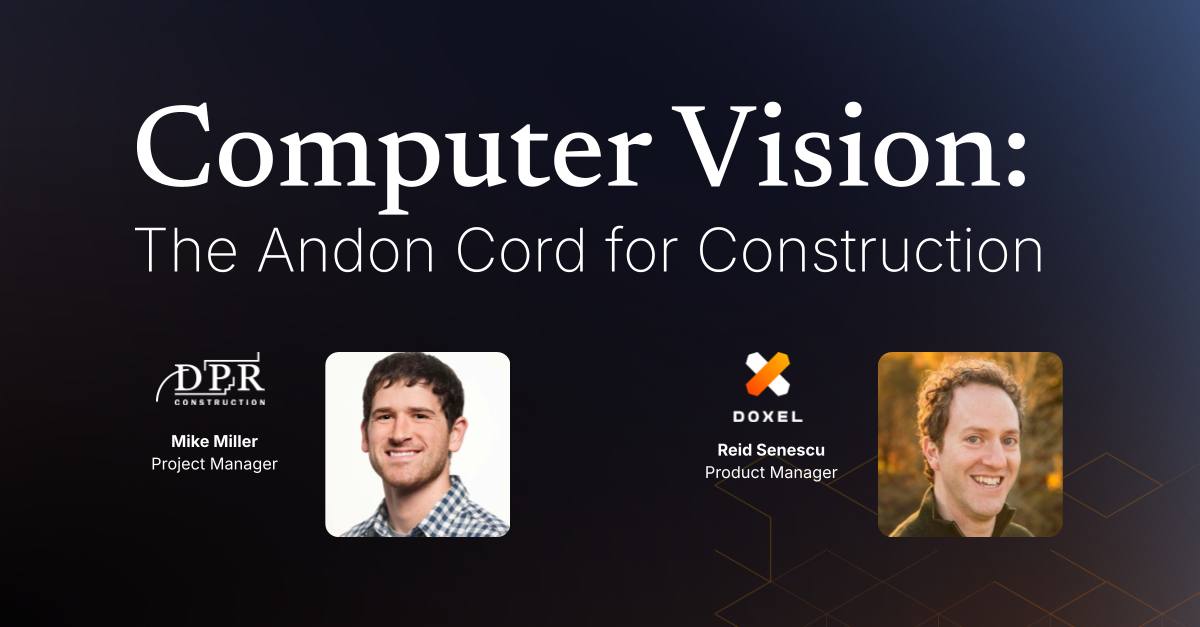
KEY INSIGHT Early detection gives leadership the visibility to have the right conversation at the right time.
The lean parallel is direct. In manufacturing, the Andon cord's value isn't the cord itself; it's the organizational culture that responds to it. Doxel's computer vision functions as a continuous Andon cord across the entire job site, flagging deviations the moment they're detectable, not weeks later when they've compounded.
Reid Senescu, Head of Product at Doxel, described the underlying principle: construction sites have historically lacked the sensor layer that lean manufacturing has always relied on. No factory would operate without real-time feedback on production output. Yet construction, which is far more complex and expensive, has run primarily on estimates and walking the site.
The system takes three inputs:
Computer vision compares the scan against the BIM to determine what has been physically installed at the component level across all trades and at every stage of construction. A large language model ties the schedule to the BIM, producing a real-time 4D view of the actual project state versus the planned state.
The result: trade and project-level progress data grounded in physical observation rather than self-reporting, updated at least weekly, with no additional engineering work required for onboarding.
Doxel has captured over 3 billion square feet of construction. That dataset powers the "rules of credit" — weighted effort models that let the system aggregate component-level data up to an accurate project percent complete.
What This Means for Owners and GCs
For owners, the implication of this story is straightforward: the capability exists to monitor capital investments in construction with the same rigor applied to financial data, inventory, or operational metrics. Requiring automated progress tracking in the RFP: specifying that it must cover all visible trades and at least 80 stages of construction is the most direct way to ensure this capability is on every project.
For GCs like DPR, the story is about competitive differentiation. The teams that build trust in objective data and act on it early catch problems before they cascade. They spend less on rework and recover faster.
The Andon cord is finally available for job sites. The question is how quickly the team can respond when it sounds.


