

.png)


See how AI-powered progress tracking helps data center teams identify schedule risks earlier and build with confidence.
Doxel is heading to Singapore for Data Centre World Asia 2026, taking place September 29–30 at the Sands Expo & Convention Centre as part of Singapore Technology Week. As an LED Wall Sponsor, Doxel will showcase how AI-powered Work-in-Place (WIP) tracking and schedule analytics help project teams identify schedule risks earlier, improve coordination, and make faster decisions throughout construction. Come visit us at booth 3G2.
Southeast Asia's data center pipeline has moved fast over the past two years. Singapore is a central hub for hyperscalers, colocation providers, and contractors racing to deliver capacity across a region where power, land, and skilled labor are tighter constraints than in more established markets.
That pressure shows up on the jobsite. Compressed schedules, fragmented regional supply chains, and delivery models that vary market to market all make it harder to know, with any confidence, where a project actually stands. Teams are still leaning on manual walk-throughs and self-reported updates to answer a basic question: is the work installed, and is it on pace with the plan?
Data Centre World Asia brings the people wrestling with that question into one room — five concurrent tracks covering the Global Stage, Keynote Theatre, Energy Security & Efficiency, Critical Infrastructure, and OCP Tech Day. It's a good cross-section of where APAC data center construction is headed, and exactly the audience we built Doxel for.
Doxel turns weekly site walks into objective, component-level progress data, tracking installed work against the plan, flagging schedule risk early, and giving owners, GCs, and trade partners a shared, factual view of where a project stands. No more disputes over whose version of “done” is right.
Teams using Doxel get:
• Automated progress tracking tied directly to the schedule
• Earlier visibility into delays, before they become critical-path problems
• A single source of truth that keeps owners, GCs, and trades aligned
• Benchmarking across projects to spot where production is slipping
For a region building as many facilities, as fast as APAC is right now, that kind of visibility isn't a nice-to-have; it's what keeps a portfolio of projects on schedule.
Doxel's team will be at booth 3G2 throughout the show: Spencer Clayton, Dom Pound-Palmieri, Jesse Gill, Hamza Abukar, and Sridhar Rengasamy, our APAC Lead. Sridhar has spent years working on large-scale infrastructure projects across Southeast Asia and is happy to share his expertise on the region.
If you're attending Data Centre World Asia and want to talk about a live or upcoming project, stop by booth 3G2 or reach out to Sridhar on LinkedIn to set up time.
We'll see you in Singapore.

LCI Congress 2026 is the place to be to see how AI-powered progress tracking gives Lean construction teams objective visibility into project progress, helping improve planning, coordination, and delivery.
Doxel is excited to return as a sponsor of LCI Congress 2026, where owners, contractors, designers, and Lean practitioners will explore the strategies and technologies shaping the future of project delivery. Taking place October 12-16, 2026, in Atlanta, Georgia, LCI Congress brings together construction leaders focused on improving collaboration, reliability, and continuous improvement.
Date: Thursday, October 15, 2026, 3:45-4:30 PM

Panelists:
- Moderator - Chris Vine, LCI-CPC, DBIA, CM-Lean Champion, Project Superintendent, Hensel Phelps
- Speaker - Brandon Bergener, Sr. Superintendent, Layton Construction Company LLC
- Speaker - John Rewolinski, Head of Schedule Analytics, Doxel
Lean construction depends on accurate, timely information. Yet many teams still rely on manual jobsite walks and spreadsheets to understand project status.
Doxel's AI-powered Work-in-Place (WIP) tracking gives Lean teams objective, real-time visibility into construction progress, helping project teams compare plan versus actual performance, improve coordination, and identify schedule risks earlier.
Whether supporting Last Planner System®, Takt planning, or flow reliability, Doxel provides trusted progress intelligence that helps teams make faster, more informed decisions.
Stop by Booth #113 to learn how leading construction teams are using AI-powered progress tracking to:
We're also proud to sponsor the LCI Congress Golf Tournament, including Hole #6 and the TaylorMade Golf Kit giveaway.
LCI Congress 2026 | October 12-16, 2026
Signia by Hilton | Atlanta, Georgia
Visit Booth #113 to how AI-powered progress tracking is helping teams deliver projects with greater certainty, consistency, and confidence.
The conference brings together leaders focused on solving the biggest challenges in AI infrastructure, including prefabrication, digital construction, power availability, and accelerated project delivery.
Doxel is heading to the Builtworlds Buildings Conference: Data Centers & AI Infrastructure to demonstrate how AI-powered progress tracking helps owners and contractors reduce schedule risk and accelerate data center delivery.
AI infrastructure projects are growing larger, faster, and more complex, making objective progress visibility more important than ever.
The event takes place September 30 to October 1 in Nashville, Tennessee. As a Premier Sponsor, Doxel will showcase how AI-powered Work-in-Place (WIP) tracking and schedule analytics help project teams identify schedule risks earlier, improve coordination, and make faster decisions throughout construction.
Thursday, October 1 | 2:10 PM – 2:50 PM

Speakers
What is reality on your jobsite? Your P6 says one thing, your trade partners say another. On a hyperscale data center, having near real-time, objective progress data helps you make better decisions to stay on schedule. In this session, a DPR superintendent and Doxel product leader share real stories from the field: catching a piping trade's slide months before it became a crisis, discovering security rough-ins installed three feet off design, and proving drywall was way ahead of schedule to a skeptical client with a single click.
Join Reid Senescu and Mike Miller as they share how computer vision turns weekly 360° site walks into objective, component-level progress data that keeps trades on plan, settles disputes with evidence instead of arguments, and drives the coordination conversations that build data centers faster. You'll leave with practical adoption lessons—including why a dashboard on the wall beats a hyperlink in an inbox every time.
This year's conference focuses on the challenges shaping modern AI infrastructure, including prefabrication, digital construction, power availability, and project delivery. These priorities align closely with Doxel's AI-powered Work-in-Place (WIP) tracking and schedule analytics, giving project teams objective insight into progress so they can reduce risk and make faster decisions.
Visit Doxel during the conference to learn how leading data center teams are using AI to:
We look forward to connecting with owners, contractors, and technology leaders at BuiltWorlds to discuss how AI-powered progress tracking is helping deliver the next generation of data centers with greater certainty.
Doxel heads to Denver on August 21 for DICE Rockies, where our VP of Mission Critical, Daniel Cheney, discusses Accelerating Development: Balancing Total Cost of Ownership and Speed to Market.
August 21, 2025 | Denver, CO
Event: DICE Rockies – Data Center Investment Conference & Expo
Doxel is heading to Denver for DICE Rockies 2025, the leading event for those tracking the explosive growth of the region’s data center market. As AI demand accelerates and power constraints grow tighter, developers and contractors are facing new challenges in site selection, cooling, and operational resiliency.
This year, our VP of Mission Critical, Daniel Cheney, will take the stage with practical insights on what it takes to deliver large-scale projects when every day and every dollar counts.

In this session, Daniel will share lessons from the field on how to move quickly without sacrificing control. He’ll dive into how owners and builders are optimizing schedules and budgets using real-time progress tracking, especially in high-stakes environments like the Rockies.
Doxel’s AI-powered visibility platform helps teams spot issues early, make informed decisions, and stay on track through every phase of construction.
At DICE Rockies, we’re looking forward to deeper conversations on:
These are the questions defining where and how mission critical projects move forward. With better field visibility, teams can respond faster, make smarter trade-offs, and deliver with confidence.
Let’s connect in Denver and talk about how AI can help you build with speed, certainty, and control.
Doxel Joins Oracle Innovation Lab Tour at AGC Tech Conference 2025
Doxel is hitting the ground in Chicago for a unique opportunity at the AGC Technology Conference — the Oracle Innovation Lab Tour. This isn't your typical conference booth. It's an immersive, hands-on experience where general contractors, schedulers, and construction pros can see construction tech in action.
📍 Location: Oracle Innovation Lab, Chicago
📅 Date: August 5, 2025
🔗 Event Page

Instead of a trade show floor setup, Oracle’s Innovation Lab offers an interactive, small-group format. Doxel will be giving live demos at our dedicated station as attendees rotate through the space. No passive presentations. This is a working session where real conversations unfold.
Participants will get a close look at how Doxel replaces slow, manual tracking with automated AI progress verification that ties directly into scheduling tools like Oracle Primavera P6. Our technology empowers field teams and project managers with objective data to catch problems early and stay on schedule.
This event is designed for construction professionals who value practical, field-ready innovation. You’ll see firsthand how Doxel fits into Oracle’s broader CE Suite ecosystem, alongside solutions from VREX, Skydio, Realwear, Anybotics, and other partners.
We’re helping project teams:
From 9 AM to 4 PM, the day includes immersive tech sessions, a product roadmap overview, networking, and lunch. It’s a chance to talk shop with peers, swap insights, and see how integrated tech can drive your projects forward.
Whether you're an executive, scheduler, or site leader, this event shows how Doxel’s AI closes the gap between the plan and the field.
Doxel heads to DICE South as David Brody joins the panel on modern data center construction.
We’re excited to return to Texas for DICE South, the premier data center investment and construction summit hosted by Bisnow. Taking place in Dallas on August 6, 2025, this event will once again bring together the most forward-thinking leaders shaping the future of hyperscale, colocation, and edge data center development.
📍 Location: Dallas, TX
📅 Date: August 6, 2025
🔗 Event Website
Featured Panel:
This year, Doxel’s own David Brody, Market Development Manager, will speak on this featured panel.
With demand for AI infrastructure and compute capacity at an all-time high, construction teams are under pressure to deliver at unprecedented speed and scale, all while meeting aggressive sustainability goals.
This panel will explore how top builders are navigating real-world constraints, including supply chain volatility, labor shortages, and increasingly complex building projects.

David Brody helps construction teams adopt AI-powered tools that automate progress tracking — so they can focus on managing safe, efficient projects instead of counting components. David started his career in operations, working closely with VDC teams, data engineers, and field experts to turn raw site data into actionable insights. His focus has always been on bridging the gap between construction realities and technical solutions, and he’s passionate about making complex systems feel simple, useful, and scalable.
What makes panels like this so valuable? They’re rooted in truth from the trenches. Expect direct insights from builders and owners who are solving real-world problems — and learn how tech-forward strategies, such as AI-powered progress tracking from Doxel, are enabling faster decisions, fewer delays, and more predictable project outcomes.
We see DICE events as essential touchpoints with the people driving the data center industry forward. From project owners and general contractors to integrators and investors, DICE South is where meaningful conversations happen, especially in critical regions like Texas.
Want to learn more about how Doxel is helping data center teams build faster with confidence?
👉 Explore our data center solutions

Integration merges cloud-based collaborative planning with automated progress tracking – giving builders a living schedule that validates itself.
REXBURG, Idaho, and MENLO PARK, Calif., July 25, 2025
Construction teams still lose hours reconciling what the schedule says with what the field delivered. Today allucent, a leader in cloud-based collaborative construction scheduling, and Doxel, the pioneer in AI-powered automated progress-tracking, announced a strategic partnership that ends the guesswork. The joint offering feeds AI-verified, trade-level progress from Doxel directly into allucent plans, cutting manual updates by 95% and accelerating project delivery by 11%.

For many construction professionals, keeping the schedule updated and useful is a constant challenge. allucent stands apart in the scheduling space by combining the rigor of Critical Path Method (CPM) scheduling with the collaborative nature of Lean construction planning in one cloud-based platform. It offers intuitive tools for pull planning, 5-week lookahead schedules, and even tracks metrics like Percent Plan Complete (PPC) to improve reliability. Unlike traditional scheduling software, allucent was built with field teams in mind – it’s easy to use on site and expands functionality and collaboration of existing scheduling solutions like Primavera P6®, Microsoft Project®, and Oracle Primavera Cloud (OPC)® . This flexibility means superintendents, trade foremen, and project managers can all engage with the schedule dynamically, aligning daily tasks with the master plan without the usual friction.
allucent’s users have reported significant efficiency gains. Kitchell’s Director of Scheduling noted that allucent made their schedule updates “much quicker and more accurate”. Another Senior Superintendent reported that allucent “cuts our meeting time by several hours” each week. These time savings are critical on fast-paced jobs – every hour freed from manual updates or lengthy coordination meetings is an hour refocused on actually executing work in the field.
On the other side of the equation, Doxel brings a breakthrough in construction progress tracking. Instead of relying on manual reporting or best-guess updates, Doxel uses 360° cameras and AI-based computer vision to automatically measure work-in-place on the jobsite. The system can track installed quantities across all visible trades, comparing them against the BIM model and the schedule to determine exactly how much of each task is completed and what’s behind. In essence, Doxel automates progress validation – confirming that what was supposed to be done is actually in place, down to the smallest detail.
The impact for field teams is huge: rather than spending hours walking the site with clipboards and updating spreadsheets, a Superintendent can simply have a crew member do a quick site walk wearing a hard-hat mounted camera. Doxel’s AI will capture and analyze everything in that walkthrough. Superintendents using Doxel have seen up to a 95% reduction in time spent manually tracking progress. Meanwhile, project executives and schedulers get objective, visual reports of actual vs. planned progress for every component in the project. Doxel flags any scope that’s behind the plan as “needs attention” or “at risk” so issues can be addressed early – long before they ripple into major delays. Across projects, this approach has translated into measurable results: teams using Doxel have accelerated their schedules by an average of 11% and saved around 10% on monthly cash flow due to more timely problem mitigation. In short, Doxel provides a continuous, trustworthy pulse on project status without burdening the project team.
This partnership is powerful because allucent’s and Doxel’s capabilities directly complement each other. By integrating Doxel’s real-time field data into allucent’s scheduling engine, the two companies are closing the long-standing gap between planning and execution.
For construction teams, the integration promises several tangible benefits:
“At allucent, our focus is on making construction scheduling as easy and collaborative as possible for the people actually doing the work,” said Adam Evarts, CEO and Co-founder of allucent. “By partnering with Doxel, we take that mission a step further. Now we can give our users — whether Superintendents, Project Managers, or Trade Partners — a schedule that is validated with real-world progress. It’s about trust and transparency. Field teams can trust that the plan in allucent is based on objective, up-to-the-minute data, and that keeps everyone on the same page and pulling in the same direction.”
“We built Doxel to remove the blind spots in construction projects,” said Reid Senescu, SVP of Product and MarketDevelopment, Doxel. “Integrating our AI tracking with allucent’s planning platform creates something new in this industry – a schedule that knows exactly what’s happening on site, at all times. Teams will be able to react to issues in hours instead of weeks, course correcting in real time to stay on track. A project manager can walk into the owner’s meeting with full confidence that the schedule is accurate and up-to-date. This is the new norm for how projects are managed and delivered on time.”
Both allucent and Doxel see particular opportunity in high-complexity construction sectors such as data centers, life sciences labs, aviation, semiconductor facilities, and healthcare projects. These fast-track projects involve thousands of interdependent tasks where a single delay can cascade into costly overruns. allucent’s platform is already used to coordinate intricate sequences on such projects, and now with Doxel’s automated tracking, those plans gain an extra layer of certainty and control.
For instance, consider a large hospital project: the team uses allucent to perform pull planning and create a reliable six-week lookahead plan for installing critical systems. Once work begins, Doxel’s cameras and AI continuously verify the installation progress of each system (HVAC, medical gas, electrical, etc.). If the medical gas installation falls behind by even a day, Doxel will quantify the shortfall and immediately inform allucent – for example showing that the task is only 60% complete instead of the planned 65%. The software would flag this discrepancy, alerting the project team to reallocate crews or resequence follow-on tasks (like equipment testing) sooner rather than later. This level of real-time feedback can prevent a cascade of delays down the line, keeping the overall project on schedule.
As one scheduler in the data center industry put it, having reliable, automatic progress data means teams “can hit more aggressive schedules” because they’re not guessing – they know exactly where they stand . Ultimately, the allucent-Doxel integration enables what both companies have been striving for: “more building and less reporting” . By automating away the tedious work of data collection and schedule updating, project teams can focus on actually executing work and solving problems, confident that the plan they’re working from is grounded in reality.
Allucent and Doxel have partnered to enable powerful new workflows for joint customers, starting today. The collaboration supports key use cases that benefit from leveraging both platforms together. The companies will highlight these combined capabilities at upcoming industry conferences and webinars. For more information, visit allucent.io or doxel.ai.
allucent is a cloud-based construction scheduling software provider founded in 2018 and based in Rexburg, Idaho. The allucent platform integrates traditional CPM scheduling with Lean construction workflows to create one of the industry’s most flexible planning solutions . By supporting everything from master schedules to weekly work plans and pull planning in one tool, allucent enables greater collaboration, reliability, and efficiency in project scheduling . Trusted by builders in sectors like commercial construction, healthcare, and industrial projects, allucent’s intuitive design and end-to-end Primavera P6®, Microsoft Project®, and Oracle Primavera Cloud (OPC)® integrations help teams accelerate their existing workflow and deliver projects on time. For more information, visit allucent.io.
Doxel, headquartered in Menlo Park, California , offers the construction industry’s first complete AI-driven progress tracking solution. Using 360-degree reality capture and artificial intelligence, Doxel provides accurate, real-time visibility into project status across all trades and phases of construction. The Doxel platform integrates with 3D models and project schedules to automatically validate quantities installed, flag at-risk activities, and generate visual progress reports for stakeholders . By replacing labor-intensive manual tracking with objective data, Doxel helps project teams mitigate risk and build with confidence – users have documented 95% less time spent on progress reporting and 11% faster project delivery on average when using Doxel. Learn more at doxel.ai.
How Doxel Is Bringing Real-World AI to the BuiltWorlds Construction Tech Conference
The BuiltWorlds Construction Tech Conference is one of the industry’s leading events for construction leaders embracing emerging technologies.
This year, on July 8–9, 2025, more than 500 construction decision-makers and innovators will gather at Chicago’s Convene, Willis Tower. The central question:
How do we move AI, robotics, and automation from concept to jobsite reality?
At Doxel, we believe the answer is clear — real-time clarity and automated progress tracking are the missing links between design, schedule, and delivery. That’s why top data center developers and general contractors rely on Doxel to deliver projects on time, on budget, and ahead of risk.

This year’s conference agenda explores how AI, robotics, and automation are transforming construction workflows.
Don’t miss Doxel’s VP of Product, Reid Senescu, on the main stage alongside leaders from Mortenson, RG Construction, and EllisDon.
Spotlight Session:
Innovation in Motion: Disruption That Delivers
📅 Tuesday, July 8 | 9:40–10:15 AM
📍 Convene, Willis Tower | Chicago, IL
What You’ll Learn in the Session:
It’s no longer enough to talk about AI’s potential. The industry needs field-ready solutions that deliver measurable results today:
With 8 of the top 10 data center developers already trusting Doxel, we’re proving that AI isn’t just a buzzword — it’s the foundation for smarter, more reliable construction.
Attending BuiltWorlds? Join Reid’s panel and connect with our team onsite. Let’s talk about how AI-powered progress tracking and predictive analytics help your projects stay on track — from groundbreaking to handover.
Event Details:
📅 July 8–9, 2025
📍 Convene – Willis Tower | Chicago, IL
🔗 Learn more and register

Doxel is proud to join the Data Center Investment Conference & Expo (DICE): National, one of the most influential events for data center developers, operators, owners, and end users. As the demand for AI and digital infrastructure accelerates, DICE National brings together industry leaders to explore the tools and strategies shaping tomorrow’s data centers.
Doxel is proud to join the Data Center Investment Conference & Expo (DICE): National, one of the most influential events for data center developers, operators, owners, and end users. As the demand for AI and digital infrastructure accelerates, DICE National brings together industry leaders to explore the tools and strategies shaping tomorrow’s data centers.
Onsite Construction: Implementing The Best Tools and Technology for Project Delivery
Panel Speaker: Reid Senescu, VP of Product Management, Doxel
Panelists:
📍 Location: Virginia, USA
📅 Date: Tuesday, May 20 – Thurs, May 22, 2025
🔗 Event Page
Reid will join fellow experts to discuss how modern construction technology is driving better outcomes—from reducing rework to improving schedule certainty and visibility in the field. Doxel’s Automated Progress Tracking solution is helping teams deliver with speed, precision, and control—at scale.
As the industry scales to meet global data center demand, Doxel is proud to support owners and builders with the technology to keep pace—on time, on budget, and with full transparency.
Stop by and learn how we’re helping construction teams build smarter, and deliver physical intelligence.

Doxel is excited to join DCAC Europe 2025, Europe’s premier event for advancing digital infrastructure. Held in Dublin, this two-day summit brings together the top minds in data center design, engineering, and construction to tackle challenges in speed, scale, and delivery certainty.As pressure grows to deliver high-performing data centers faster and more reliably, DCAC Europe provides a critical forum for exploring how innovation is reshaping project execution across the region.
Doxel at DCAC Europe 2025: Accelerating Progress with AI-Powered Visibility
Doxel is excited to join DCAC Europe 2025, Europe’s premier event for advancing digital infrastructure. Held in Dublin, this two-day summit brings together the top minds in data center design, engineering, and construction to tackle challenges in speed, scale, and delivery certainty.
As pressure grows to deliver high-performing data centers faster and more reliably, DCAC Europe provides a critical forum for exploring how innovation is reshaping project execution across the region.

📍 Location: Dublin, Ireland
📅 Date: May 13–14, 2025
🔗 Event Page
Doxel’s Advanced Progress Tracking equips teams with real-time visibility into progress—improving alignment with plan, reducing rework, and enabling faster decisions on the ground. As the industry adopts more ambitious build schedules, tools that reveal truth on the jobsite are more essential than ever.
At Doxel, we believe visibility drives velocity. We’re proud to support the construction leaders building tomorrow’s infrastructure—and we’re here to learn, collaborate, and grow with the industry.
Big things are happening in Dubai. Doxel is headed to DCD>Connect MENA 2025!
Doxel is proud to participate in DCD>Connect MENA 2025, one of the most anticipated data center summits in the region. With demand for digital infrastructure skyrocketing across the Middle East, this event brings together key stakeholders to address the challenges of building capacity at scale.

Daniel Cheney will join a high-profile panel alongside leaders from Batelco, CIB Egypt, Nxtra Africa, and Pure Data Centres Group to discuss the future of data center construction and how to keep pace with rapid regional growth.
📍 Location: Dubai, UAE
📅 Date: April 16, 2025
⏰ Time: 15:00–16:00
🎤 Panel: DCD>Major Panel: Building the Future – Meeting Booming Capacity Demands in the Region
🧑💼 Panelists: Daniel Cheney, VP of Sales, Doxel; Sayed Hasan Amin, Head of Operations, Batelco; Yashnath Issur, CEO, Nxtra Africa; Hosam Mohie, Data Centers Manager, Commercial International Bank Egypt; Steffen Zimmermann, Project Director, Pure Data Centres Group
Attendees will hear from major developers and technology providers on topics such as hyperscale expansion, schedule certainty, workforce constraints, and sustainability. Doxel will showcase how construction teams can improve outcomes using its AI-powered Work-in-Place (WIP) tracking platform, enabling real-time comparisons of field progress against the plan.
As new markets emerge and capacity demands surge, speed, transparency, and control are more important than ever. “Meeting capacity demand in MENA isn’t just about building faster—it’s about building smarter. Doxel equips data center teams with the tools to drive measurable improvements in speed, cost, and reliability.”
– Daniel Cheney, VP of Sales

By continuously tracking and analyzing construction site progress in real time, Production Rate Data serves as a single, reliable source of truth for measuring construction progress.
Traditionally, project managers have relied on site visits and progress reporting from their field teams to stay abreast of construction progress. On large capital projects like data centers, semiconductor wafer fabrication plants, or healthcare infrastructure this can become problematic where even small schedule delays lead to large cost overruns. Doxel’s Production Rate Data provides a solution that empowers project teams with additional data in order to monitor construction progress.

Production Rate Data is the information gathered through reality capture inputs (e.g., 360-degree imaging or drone footage), to continuously track and analyze construction site progress in real time. By comparing actual work completed against the planned schedule, this data serves as a single, reliable source of truth for measuring construction progress. It provides project owners with objective, accurate insights that are crucial for managing schedules and ensuring on-time project completion. This innovative approach equips teams with the data needed to identify delays, optimize workflows, and ensure efficient project delivery.
By leveraging this advanced technology, owner’s representatives can monitor projects with a data set they control, guaranteeing transparency and accuracy. Here’s how Doxel tracks completed construction:
Example: Mechanical Pipes and Walls

Doxel’s Production Rate tracking capability simplifies the comparison of completed construction against the schedule, offering a powerful tool for project owners to measure progress and manage schedules effectively.
Understanding how construction software tracks progress can be complex. Doxel simplifies this with a robust methodology:

Productivity is calculated using specific units of measure for each stage based on your work breakdown structure (WBS) in Primavera P6. For example, if the plumbing installation requires 100,000 linear feet of pipe, the unit of measure would be linear feet. The planned number would be 100,000, against which completed construction is measured.
As construction progresses, Doxel updates the number of completed activities. For instance, if only 20,000 linear feet of pipe have been installed for the drainage system, the 360-degree imaging would capture the work, and Doxel would update the percentage of completion for both the stage (drainage system) and the trade (plumbing) to 20%.
To help manage schedules effectively, Doxel introduced the Production Forecasting Calculator. This tool allows users to simulate different scenarios by adjusting crew sizes and production rates to forecast completion. General contractors can manage subcontractors to ensure they stay on schedule. At the same time, owner’s reps can monitor production rates remotely, gaining confidence that construction progress is on track based on actual data.
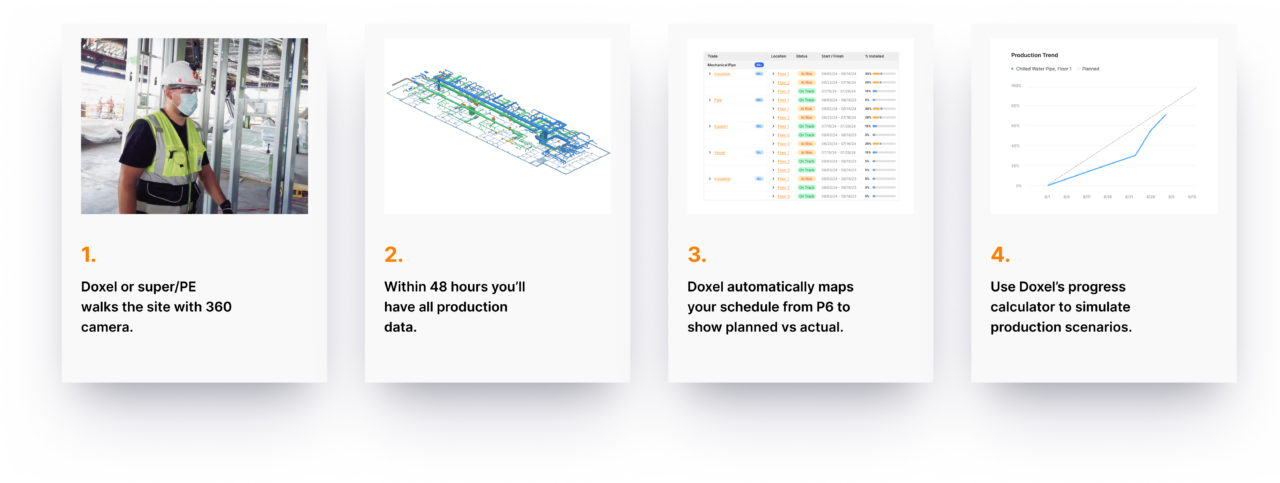
Production Rate Data compares completed construction against your schedule, providing a single source of truth for measuring construction progress. Doxel’s system allows you to manage productivity for each stage of the construction project by trade, zone, and floor. This capability empowers project owners with a controlled data set that facilitates better communication with general contractors and helps address potential schedule delays proactively.
By giving project owners control of the data, Doxel ensures a higher level of transparency and efficiency in construction management. This innovative approach enhances collaboration and significantly reduces the risk of delays, optimizing time and resources. With Doxel’s Production Rate Data, project owners can confidently steer their projects to successful completion.

Accurate and reliable progress tracking is essential for effective communication and coordination, especially with multiple stakeholders and a higher level of complexity. Automated construction progress tracking can meet these requirements and reduce manual effort, helping you complete your projects faster and on-budget.
Healthcare construction is more complex and has a lot at stake. If not done right, these projects can be costly for everyone involved. Healthcare projects also require a higher attention to detail to keep everything running smoothly.
With more stakeholders involved in the process, companies need to be able to benchmark and be equipped for better prediction, transparency, and ultimately the ability to detect (and curb) problems, deviations, and cost overruns.
Automated progress tracking can meet these requirements and reduce manual effort, helping you complete your projects faster and on-budget.
Progress tracking is critical for project success in healthcare because it allows for real-time monitoring of project performance and a faster identification of issues and challenges, and implementation of corrective actions.
By regularly monitoring progress and performance, project managers and teams can quickly identify areas that are falling behind schedule or budget—and take the necessary steps to address them before they become major issues. Accurate and reliable progress tracking is essential for effective communication and coordination, especially with multiple stakeholders and a higher level of complexity.
Progress tracking can be beneficial beyond one single project, too. Objective progress data and insights can also help to identify areas of success and best practices that can be replicated in other projects, improving overall project performance and company-wide outcomes.
Automated progress tracking can improve transparency during hospital construction by providing real-time, accurate information on the progress of the project. Automated systems can be configured to collect data from a variety of sources, create a single source of truth and present the information in a format that is easy to understand and always accessible.
With the enhanced, real-time visibility that automated progress tracking brings, stakeholders are able to see exactly where the project is at any given time. This clear picture of project status helps improve communication, transparency, and accountability with objective data that eliminate any debate in progress tracking.
Automated progress tracking is a faster way of providing stakeholders with access to the same information. With an automated system, stakeholders are able to see the same data and reports, regardless of their location. Ensuring everyone is working with the same information saves time in reporting and mitigates the possibility of miscommunication or misunderstanding.
Since hospital construction projects often involve large sums of money and have a significant impact on patient outcomes, it’s also useful to have an auditable record of each project’s progress that can be used in demonstrating accountability to funders and regulatory bodies.
Healthcare construction projects need an efficient way to manage and mitigate risk. Proper real-time visibility into the progress of the project can help spot potential issues before they become major problems. This enables project managers and other stakeholders to take proactive measures, rather than waiting until it is too late to take corrective action.
For example, if progress tracking reveals a particular aspect of the project is running behind schedule, the project manager may be able to adjust the project plan to effectively avoid potential delays or cost overruns.
Additionally, progress tracking can help project managers manage and coordinate dependencies between different parts of the project, which further reduces the risk of delay, prevents trade stacking, and mitigates other issues arising from one part of the project impacting others.
Progress tracking can help with benchmarking by providing a clear understanding of the current status of the project, including the status of all trade and any related delays or setbacks. This data can then be used to compare the project’s progress against similar projects or industry standards, making it easier to identify areas where improvements can be made.
With multiple sources of information on a single project, a digital progress tracking tool can deliver accurate data to one shared source of truth, making benchmarking markedly easier.
Additionally, progress tracking stored data can be leveraged for benchmarking future progress against previous internal projects for better forecasting future project and completion dates, as well as for identifying potential cost savings or other opportunities to optimize the project.
The more detailed information teams have on the progress of a project, the more proactive they can be to keep it on track. Identifying potential issues early on allows for corrective action to be taken sooner rather than later, reducing hours, rework, and delays to deliver projects on time and on budget. But detailed and timely progress tracking shouldn’t come at the cost of crews’ time and resources.
That’s where a solution like Doxel’s automated progress tracking can help. Doxel significantly reduces hours tracking progress, while delivering accurate, reliable objective insights that improve communication and transparency across all stakeholders.
Click here to learn more about how Doxel’s AI-powered progress tracking paired with 360-degree video capture can help ensure hospital construction projects stay on track and on budget.

Healthcare construction teams that leverage AI-powered performance monitoring are armed with accurate data in near real-time to keep projects on track.
Healthcare construction is a specialized niche in the industry, and the projects within it require a high standard of attention to detail to meet their deadlines. These projects are complex and involve the coordination of large, cross-functional teams to complete them on tight schedules—which means a project’s success is majorly dependent on the efficiency and collaboration of the team building it.
Every day that the facility is delayed or past schedule means another day patients can’t come in, and the owner or company will lose money.
Enter, AI-powered project controls – automated construction progress tracking.
The construction of healthcare projects is a delicate balance of innovation and realism. As one of the more technology-driven sectors, these facilities aim to have the latest and greatest equipment, but at the same time needs to be planned months in advance and available within a certain deadline. Teams must stay on top of an ever-changing landscape and varying demands—so having accurate, objective project progress data throughout is essential.
One of the biggest factors to staying on schedule is knowing exactly where you are. Without a single view of project progress, sticking to a set schedule becomes a risky guessing game. Progress tracking using the power of computer vision enables project teams to build faster and more accurately together.
After all, knowledge is power. Teams that leverage AI-powered performance monitoring are armed with accurate data in near real time to see backwards at what’s been done, as well as ahead at predictive insights.
Rework can be a project schedule’s worst nightmare—and the later it’s caught the bigger a scheduling headache you have on your hands. Rework takes valuable time away from what should be forward progress. In order to achieve schedule predictability, a project team has to be able to spot (and avoid) potential rework on the critical path.
Using computer vision automated construction progress tracking that acts as a digital surveyor, superintendents can quickly catch any missing or incorrectly installed components before the next trade covers up the error. This foresight can help avoid weeks of delays and schedule compression, which ultimately helps the facility stay on track to open on time or earlier.
Real-time automated construction progress tracking doesn’t just help with new healthcare construction—it can also help reduce downtime during facility operations down the road.
Picture it (if you dare): A construction company closes off an area to cut into the wall and fix MEP services only to discover that it wasn’t installed per as-built plans. Instead of adhering to the plan, dreaded rework is now required.
But what if you had x-ray vision instead? Comprehensive reality capture of an as-built facility ensures maintenance teams know exactly what was installed and where, so any maintenance and retrofits can be done efficiently without the rework. Instead of costing days of downtime, teams can get in and get it done as planned the first time.
At its core, Doxel is automated construction progress tracking that provides objective, accurate data on materials installed for real-time project controls. The more teams can document in the moment, the more productive and proactive they become.
Find out how healthcare projects have used Doxel to deliver facilities earlier and at a higher standard of quality.

Doxel is thrilled to partner with Corscale in revolutionizing the landscape of data center construction, setting a new standard for the industry.
Gainesville, VA – (November, 2023) – Corscale, the exclusive data center platform of the Patrinely Group, has announced that it will be deploying Doxel, the leader in AI automated construction progress tracking to speed the pace of construction and reduce waste on upcoming data center construction.
“Corscale is focused on implementing industry leading construction and sustainability initiatives. We are committed to building efficiently. Doxel will help us accelerate construction schedules and deliver critical data centers faster.” said Nic Bustamante, Chief Technology Officer for Corscale. Prior to his current position, Nic was the Senior Vice President of Development at Corscale and held leadership roles at Apple, Google, and Microsoft.
The rise in artificial intelligence, specifically Natural Language Processing (NLP), computer vision, and machine learning, and robotics, is increasing the already strong demand for data center solutions. Corscale will now harness the power of AI to build the data centers that deliver AI.
“Doxel is thrilled to partner with Corscale in revolutionizing the landscape of data center construction. Corscale’s commitment to industry-leading initiatives aligns with Doxel’s mission to transform construction through the power of AI. We aim to enhance the efficiency and sustainability of constructing data centers, setting a new standard for the industry. This collaboration represents a significant stride toward the future, where AI not only powers data centers but also drives their seamless and sustainable construction.” – Saurabh Ladha, CEO of Doxel.
The partnership with Doxel reflects Corscale’s forward-thinking approach to stay at the forefront of technological advancements. By incorporating AI into the construction process, Corscale not only meets the rising demand for data center solutions but also pioneers a path toward intelligent, sustainable, and swift data center deployment.
Corscale Data Centers is focused on delivering sustainability at scale. As the exclusive data center platform of the Patrinely Group, Corscale, together with its capital partner USAA Real Estate is delivering tomorrow’s data center, today. The company has assembled a top-tier team of industry professionals who bring decades of experience designing, building, and operating sustainable, high-density data centers for some of the largest and most sophisticated hyperscale operators and enterprises. Corscale delivers highly scalable, secure, and energy-efficient build-to-suit powered shells as well as flexible modular deployments. To learn more, please visit Corscale.
Doxel is focused on speeding up construction and reducing waste by using AI to automate progress tracking. Doxel believes in the power of aligned teams and designed Doxel to unlock their full potential. With Doxel, owners have full observability on their site while providing their field teams with powerful tools that prevent delays, over-billing, re-work, and trade stacking. Backed by Insight Partners, Amplo, and Andreessen Horowitz and with a growing team of engineers, scientists and construction veterans, Doxel is driven to help their customers win.
For media inquiries, please contact:
Corscale Media Relations
press@doxel.ai
Doxel Media Relations
press@doxel.ai

Accurate, reliable data allows construction companies to remove subjectivity and replace it with objective accountability.
Communication can make or break a construction project. A report from the Project Management Institute found that ineffective communication was the main contributor to project failure one-third of the time. An even more alarming finding from the research is that 56% of budgets allocated to projects are at risk due to poor communication.
Without objective insights alignment among field and office teams, knowing what’s happening on a project becomes a daunting task—one that could put a project (and its profitability) at risk.
1. Delayed communication
Timely communication (especially between the field and the office) is hard to achieve. Field teams are focused on a hundred different things at once, and relaying project updates typically happens at the end of their day. Because field leaders aren’t able to instantly communicate every facet of a project’s progress as it happens, there is a lag time and gap in each day’s reporting.
2. Inconsistent communication
In addition to being delayed, communication from the field to the office isn’t always consistent. The more variables and people added to the equation, the more potential for confusion and uncertainty. Communication on a project can very quickly turn into a game of telephone—and teams are forced to hold more meetings and conversations to ensure mutual understanding.
3. Missing communication
While delayed and inconsistent communication can hold a project back, missing communication can halt it entirely. If proper communication isn’t happening, neither is profitable building.
All these challenges in communication don’t just create extra stress and work on a project—they can have a deeper impact on the data and tracking, too. Without everyone on the same page, the reporting and insights are left to everyone’s individual perspective. As a result, the project’s insights suffer.
Accurate, reliable data allows construction companies to remove subjectivity and replace it with objective accountability. Insights that are trackable and consistent bring everyone together on the same page to make informed decisions, faster.
Improve communication and progress tracking
Streamline billing and accountability
The key to collecting reliable insights is through automated progress tracking. The right tool can increase team alignment and communication, without adding effort to the project team’s plate.
Doxel brings predictability to construction projects by providing critical insight with objective analytics. The AI-powered computer vision builds a digital twin of the jobsite on a weekly basis—providing true progress reporting and near real-time data. Doxel acts as a digital surveyor to capture and quantify project progress and eliminates the need for teams to manually calculate and report on it. The result is detailed, shared progress tracking from a single source across every project stakeholder and subcontractor.

Strategies for maintaining a healthy work-life balance.
Doxel CEO Saurabh Ladha is featured on The QTS Experience Podcast with David McCall. David and Saurabh discuss the impact of waste and rework in construction.
Saurabh discusses how Doxel integrates AI with established processes to build faster. Join us for the conversation, on the next QTS Experience. Episode 191; Saurabh Ladha: Intuitive Construction, AI, Doxel, Innovation, Data Center.

Advice for maintaining mental health in the workplace.
Many construction companies are at a crossroads as they think about the future of their business, and who will be a part of it.
More than 40% of the current U.S. construction workforce is expected to retire over the next decade. This generation of seasoned superintendents and project leaders will leave behind big shoes to fill in both skill and knowledge, and the industry’s current skilled labor shortage doesn’t exactly help either.
While many owners, GCs and trade contractors have programs in place to mentor younger generations and train them to step in, it won’t be enough to bridge the gap. That’s why it’s important for companies to ensure they are innovating to attract more workers of a new generation.
The construction industry has made huge strides to change and adopt more technology, but it can’t stop now. The younger generation that’s coming into the workforce over the next ten years was raised in a time where technology was already prevalent and is like second nature to them.
If a company wants to attract and retain a new generation of field leaders, they need to have processes in place that don’t just utilize technology, but are on the forefront of innovation, too.
A project isn’t truly done until it’s done done. And whether or not it gets to done done on time and under budget all comes down to how it’s being tracked during the construction phase. The old way of progress tracking involves a ton of manual effort and even more paper. Field teams would have to document what happened by hand on a regular basis and manually report on the overall progress completed.
Not only was this inefficient and extremely time-consuming, it also made it nearly impossible to try to predict where the project was headed or spot any potential issues fast enough to fix them. Even with the utilization of 3D and BIM models, knowing where a project stands hasn’t been as automated as it should be.
Convincing new, younger workers to take on these outdated processes isn’t an easy sell. Chances are, they’ll feel their time is being wasted since they are so used to the convenience and automation that technology can bring. In order to attract more workers to be on project and field teams, the processes they follow need to be seamless and even a little exciting.
Construction companies that are leveraging artificial intelligence and machine learning to automate the collection and analysis of project data are already ahead of the game. While the new generation may be more traditionally more technologically savvy, AI is new and exciting to everyone.
Rather than spending hours per week manually inputting and calculating progress and materials, solutions like Doxel use AI alongside 360-degree capture to automatically identify true, objective progress. This ability to bring predictability to projects doesn’t just save field teams time—it provides critical insights that help avoid delays and cost overruns at the overarching project level.
Instead of them feeling like just another cog in the machine there to collect data over and over again, technology of this caliber empowers workers to think critically about the status of projects and seek a deeper understanding of what’s happening each day. Not to mention the sense of fulfillment that comes when a team works together on a project that is able to be completed earlier with increased safety, less expense, and higher quality.
We can help you empower a new generation of field leaders. See how Doxel works in a personalized demo today.

Doxel’s computer vision-based progress tracking leverages AI to act as a digital surveyor that delivers insights and reporting in real time.
Now more than ever, construction companies are looking for ways to stand out from the competition—and that starts with staying on top of the latest technology that helps them build more efficient, profitable projects.
The future of construction technology will be a hybrid of artificial intelligence (AI) and machine learning working alongside the industry’s workforce.
But what does that mean?
Put more simply, artificial intelligence is the brain of the computer, and machine learning is the part of that brain that learns from data and makes informed decisions based on what it has learned.
Computer scientists have found a way to make the process of designing a building more efficient and accurate. By starting with the goals and parameters of a project, generative design is able to explore every possible iteration of a solution until it comes up with the best option.
This technology and its use has the potential to save architects and designers countless hours upfront—but it doesn’t replace the human touch completely. Once the optimal solution is found for the design of a building, a designer still needs to fine-tune the details and take it from there.
Robots are being utilized on construction projects to perform repetitive tasks (such as bricklaying) using AI to detect changes in conditions and maximize efficiency. While only a few robots have been added to the project ranks so far, it is expected that more of these AI-powered workers will be used as a method of streamlining productivity.
What’s our favorite robot in construction, you ask? Meet Spot: a robot dog created by Boston Dynamics used to carry image-capturing or laser scanning equipment that ventures where humans can’t. Spot’s ability to walk himself autonomously around a jobsite, including on uneven terrain, makes him a project’s best friend. Spot may not have AI infused into his DNA yet, but the future generations of Spot will incorporate AI for predictive and preventative analysis.
Milwaukee Tool first dabbled into the technology space with their wirelessly connected tools, but they’ve since enhanced their capabilities with AI to pinpoint the exact locations of where a tool was last seen. And they didn’t stop there—by adding algorithms and more advanced sensors to their tools, Milwaukee is able to combine the data of a motor drive with motor load information to make decisions on false trips.
It should come as no surprise that these technological concepts are being applied to the most important priority in construction: safety. Companies like NewMetrix have created an AI-powered solution to help predict (and prevent) safety incidents on projects.
By leveraging a construction-specific AI model, their platform can analyze existing data along with their proprietary program to provide actionable incident insights that have the power to keep workers safe.
While BIM has opened the door for 3D modeling of a project, it’s still nearly impossible to tell the progress or quality of a build without a human resource to manually sift through and analyze images. That is, until now.
Doxel’s computer vision-based progress tracking leverages AI to act as a digital surveyor that delivers insights and reporting in real time. It can automatically analyze visual data, measure installed quantities, and inspect quality for more than 75 different construction stages. This not only saves companies time, it also mitigates the risk of errors and delays that could become costly.


