

.png)


See how AI-powered progress tracking helps data center teams identify schedule risks earlier and build with confidence.
Doxel is heading to Singapore for Data Centre World Asia 2026, taking place September 29–30 at the Sands Expo & Convention Centre as part of Singapore Technology Week. As an LED Wall Sponsor, Doxel will showcase how AI-powered Work-in-Place (WIP) tracking and schedule analytics help project teams identify schedule risks earlier, improve coordination, and make faster decisions throughout construction. Come visit us at booth 3G2.
Southeast Asia's data center pipeline has moved fast over the past two years. Singapore is a central hub for hyperscalers, colocation providers, and contractors racing to deliver capacity across a region where power, land, and skilled labor are tighter constraints than in more established markets.
That pressure shows up on the jobsite. Compressed schedules, fragmented regional supply chains, and delivery models that vary market to market all make it harder to know, with any confidence, where a project actually stands. Teams are still leaning on manual walk-throughs and self-reported updates to answer a basic question: is the work installed, and is it on pace with the plan?
Data Centre World Asia brings the people wrestling with that question into one room — five concurrent tracks covering the Global Stage, Keynote Theatre, Energy Security & Efficiency, Critical Infrastructure, and OCP Tech Day. It's a good cross-section of where APAC data center construction is headed, and exactly the audience we built Doxel for.
Doxel turns weekly site walks into objective, component-level progress data, tracking installed work against the plan, flagging schedule risk early, and giving owners, GCs, and trade partners a shared, factual view of where a project stands. No more disputes over whose version of “done” is right.
Teams using Doxel get:
• Automated progress tracking tied directly to the schedule
• Earlier visibility into delays, before they become critical-path problems
• A single source of truth that keeps owners, GCs, and trades aligned
• Benchmarking across projects to spot where production is slipping
For a region building as many facilities, as fast as APAC is right now, that kind of visibility isn't a nice-to-have; it's what keeps a portfolio of projects on schedule.
Doxel's team will be at booth 3G2 throughout the show: Spencer Clayton, Dom Pound-Palmieri, Jesse Gill, Hamza Abukar, and Sridhar Rengasamy, our APAC Lead. Sridhar has spent years working on large-scale infrastructure projects across Southeast Asia and is happy to share his expertise on the region.
If you're attending Data Centre World Asia and want to talk about a live or upcoming project, stop by booth 3G2 or reach out to Sridhar on LinkedIn to set up time.
We'll see you in Singapore.

LCI Congress 2026 is the place to be to see how AI-powered progress tracking gives Lean construction teams objective visibility into project progress, helping improve planning, coordination, and delivery.
Doxel is excited to return as a sponsor of LCI Congress 2026, where owners, contractors, designers, and Lean practitioners will explore the strategies and technologies shaping the future of project delivery. Taking place October 12-16, 2026, in Atlanta, Georgia, LCI Congress brings together construction leaders focused on improving collaboration, reliability, and continuous improvement.
Date: Thursday, October 15, 2026, 3:45-4:30 PM

Panelists:
- Moderator - Chris Vine, LCI-CPC, DBIA, CM-Lean Champion, Project Superintendent, Hensel Phelps
- Speaker - Brandon Bergener, Sr. Superintendent, Layton Construction Company LLC
- Speaker - John Rewolinski, Head of Schedule Analytics, Doxel
Lean construction depends on accurate, timely information. Yet many teams still rely on manual jobsite walks and spreadsheets to understand project status.
Doxel's AI-powered Work-in-Place (WIP) tracking gives Lean teams objective, real-time visibility into construction progress, helping project teams compare plan versus actual performance, improve coordination, and identify schedule risks earlier.
Whether supporting Last Planner System®, Takt planning, or flow reliability, Doxel provides trusted progress intelligence that helps teams make faster, more informed decisions.
Stop by Booth #113 to learn how leading construction teams are using AI-powered progress tracking to:
We're also proud to sponsor the LCI Congress Golf Tournament, including Hole #6 and the TaylorMade Golf Kit giveaway.
LCI Congress 2026 | October 12-16, 2026
Signia by Hilton | Atlanta, Georgia
Visit Booth #113 to how AI-powered progress tracking is helping teams deliver projects with greater certainty, consistency, and confidence.
The conference brings together leaders focused on solving the biggest challenges in AI infrastructure, including prefabrication, digital construction, power availability, and accelerated project delivery.
Doxel is heading to the Builtworlds Buildings Conference: Data Centers & AI Infrastructure to demonstrate how AI-powered progress tracking helps owners and contractors reduce schedule risk and accelerate data center delivery.
AI infrastructure projects are growing larger, faster, and more complex, making objective progress visibility more important than ever.
The event takes place September 30 to October 1 in Nashville, Tennessee. As a Premier Sponsor, Doxel will showcase how AI-powered Work-in-Place (WIP) tracking and schedule analytics help project teams identify schedule risks earlier, improve coordination, and make faster decisions throughout construction.
Thursday, October 1 | 2:10 PM – 2:50 PM

Speakers
What is reality on your jobsite? Your P6 says one thing, your trade partners say another. On a hyperscale data center, having near real-time, objective progress data helps you make better decisions to stay on schedule. In this session, a DPR superintendent and Doxel product leader share real stories from the field: catching a piping trade's slide months before it became a crisis, discovering security rough-ins installed three feet off design, and proving drywall was way ahead of schedule to a skeptical client with a single click.
Join Reid Senescu and Mike Miller as they share how computer vision turns weekly 360° site walks into objective, component-level progress data that keeps trades on plan, settles disputes with evidence instead of arguments, and drives the coordination conversations that build data centers faster. You'll leave with practical adoption lessons—including why a dashboard on the wall beats a hyperlink in an inbox every time.
This year's conference focuses on the challenges shaping modern AI infrastructure, including prefabrication, digital construction, power availability, and project delivery. These priorities align closely with Doxel's AI-powered Work-in-Place (WIP) tracking and schedule analytics, giving project teams objective insight into progress so they can reduce risk and make faster decisions.
Visit Doxel during the conference to learn how leading data center teams are using AI to:
We look forward to connecting with owners, contractors, and technology leaders at BuiltWorlds to discuss how AI-powered progress tracking is helping deliver the next generation of data centers with greater certainty.

A McKinsey report shows stagnant construction productivity for decades. By adopting modern practices, owners can drive a new era of construction productivity.
Better tools for the field and reducing risk on every project!
Long considered the backbone of economic growth, the construction industry continues to face a productivity challenge that cannot be ignored any longer. According to a McKinsey report, construction productivity has remained stagnant for decades, with the sector’s growth rate falling far behind that of the global economy.
For an industry that influences everything from infrastructure to housing, this productivity gap is not just a business problem—it’s a societal one. However, a growing consensus is that construction owners who commission and pay for projects hold the keys to transforming the industry. By leveraging their influence and adopting modern practices, owners can be the driving force behind a new era of construction productivity.
Before exploring solutions, it’s essential to understand the scope of the problem. McKinsey’s analysis highlights that construction productivity has only increased by 1% annually over the past 20 years, compared to 2.8% for the global economy. This productivity gap has resulted in significant cost overruns and delays, with projects exceeding budgets by 80% and timelines by 20 months on average. The industry must adopt new innovative technologies and practices faster to mitigate this trend.
The factors contributing to this stagnation are numerous, including:
Given these challenges, it’s clear that a radical shift is needed. And that shift can start with the owners.
Owners play a pivotal role in the construction ecosystem. They are the ones who set the expectations, define the scope, and ultimately bear the financial risk of projects. Owners can drive change across the industry by taking a more active role in risk mitigation and pushing for productivity improvements. Here’s how:
1. Adopting Performance-Based Contracts
One of the most effective ways for owners to drive productivity is by adopting performance-based contracts. These contracts tie compensation to achieving specific milestones and performance metrics, such as staying within budget or completing a project on time. This approach aligns contractors’ incentives with the project goals, encouraging them to innovate and find more efficient work methods.
2. Embracing Digital Transformation
Digital tools can revolutionize construction, from design to execution to delivery. Owners who prioritize digital transformation can see significant productivity improvements. For example, Building Information Modeling (BIM) allows for more accurate planning and coordination, reducing the likelihood of costly errors and rework. Doxel empowers construction teams with AI-driven project benchmarking and analytics, enabling faster, data-backed decisions that reduce costs and improve on-time delivery.
According to McKinsey, using digital tools could improve overall productivity by 14-15% and reduce project costs by 4-6%. Project management software can also streamline communication and collaboration, ensuring all stakeholders are on the same page.
3. Leveraging Technology for Project Benchmarking
One of the most potent tools that owners can use to enhance productivity and benchmark their projects is Doxel. Doxel is a powerful tool for project owners looking to enhance productivity and benchmark their projects. Its Production Rate tracking simplifies comparing completed work against the schedule, enabling owners to measure progress and manage timelines effectively.
The data collected from the site is analyzed to deliver precise insights into project progress, quality, and potential risks. With Doxel, owners can establish clear benchmarks, compare them against industry standards and past performances, and identify inefficiencies early. This empowers them to make informed decisions that keep projects on track, within budget, and up to the highest quality standards.
By integrating Doxel into their project management practices, owners gain a significant competitive advantage, ensuring precision and efficiency in every project.
4. Fostering Collaboration and Integration
The fragmentation of the construction industry is a significant barrier to productivity. Owners can address this by fostering a more collaborative and integrated approach to project delivery.
Integrated Project Delivery (IPD) is one such approach, where all parties—owners, contractors, architects, and engineers—work together from the outset, sharing risks and rewards. This collaborative environment encourages innovation and problem-solving, improving outcomes for all involved.
5. Prioritizing Sustainability and Resilience
Sustainability and resilience are increasingly important in construction, not only for environmental reasons but also for long-term cost savings and productivity gains. Owners who prioritize sustainable practices, such as energy-efficient designs or renewable materials, can reduce their projects’ lifecycle costs. Furthermore, resilient designs that withstand extreme weather events or other disruptions can minimize downtime and maintenance costs, ensuring the project remains productive over its lifespan.
A skilled workforce is crucial for enhancing construction productivity, but the industry is currently grappling with a significant labor shortage. With many skilled workers nearing retirement and fewer young people entering the field, construction projects face increasing risks. However, Owners can address these challenges by investing in the right technology, such as Doxel, which offers three key solutions to keep projects on track:
(1) Accelerating the onboarding process due to its ease of use,
(2) Boosting jobsite worker productivity, and
(3) Enabling project leaders to identify when additional skilled trades are urgently needed to meet schedules.
Feedback from our clients highlight that Doxel helps onboard new engineers quickly, bringing them up to the level of experienced superintendents. Moreover, Doxel reduces the time spent manually tracking progress by 95%, freeing up the most skilled team members to focus on higher-value tasks.
While attracting more people to the industry is vital, a long-term perspective is essential. However, Doxel provides an immediate impact by optimizing the available labor on-site. For skilled trades, Doxel’s production rates are particularly valuable. They empower superintendents with hard data, allowing them to demand additional labor from trade partners when it’s clear that the current workforce won’t meet project deadlines. This data-driven approach helps ensure that projects stay on schedule and that trade partners fulfill their commitments, avoiding potential liabilities for delays.

Featured Case Study:
Layton Construction’s experience with Doxel has been transformative, particularly regarding time savings and efficiency. On a recent 82,000 SqFt healthcare facility project, six superintendents and project engineers were initially spending a combined 60 hours per week manually tracking progress. With Doxel’s technology, this time was slashed by 95%, reducing the task to just 3 hours total. This significant reduction in manual labor translates to 57 hours saved weekly, allowing the team to redirect efforts toward safety, quality, and effective coordination with trade partners—resulting in an additional $2.17 per square foot per year being reinvested into these critical areas.
The benefits continued beyond time savings. Doxel enabled a 10% reduction in overbilling by providing precise progress tracking, simplifying billing processes, and eliminating disputes over the percent complete. Additionally, Doxel’s production rate tracking made it easier to secure commitments from trade partners to meet deadlines, ensuring the project stayed on time. As Brandon Bergener, Superintendent at Layton Construction, noted, Doxel has also made it easier to access additional manpower when needed, further enhancing project efficiency and productivity.
When owners lead in driving productivity improvements, the benefits extend beyond individual projects. Here are some of the broader impacts:
While the potential benefits are clear, driving productivity improvements in construction is challenging. Owners may encounter resistance from contractors accustomed to traditional working methods or stakeholders who are wary of the costs associated with new technologies. To overcome these barriers, owners should:
The construction industry is at a crossroads. It must overcome its productivity challenges to remain cost-effective and meet future demands. With their unique influence and authority, owners are in the best position to lead this transformation. Owners can drive the industry forward by adopting performance-based contracts, embracing digital tools, fostering collaboration, prioritizing sustainability, and investing in workforce development. The time for change is now, and the future of construction lies in the hands of those who are willing to push it forward.
Delivering on construction productivity is no longer optional—it’s essential. By taking a proactive role, owners can unlock the full potential of their partners and projects and set a new standard for the industry as a whole.
Citations:
McKinsey & Company. “Delivering on construction productivity is no longer optional.” Retrieved from McKinsey & Company.

For general contractors and owners, AI-powered progress tracking ensures accuracy by providing a single source of truth on percentage completed.
At their core, construction projects rely on cash flow. But it isn’t always simple—considering the complexity of projects and the fact that a company is likely managing multiple of them at once. Some projects take months or years to complete, and payments happen throughout the entire duration.
With so many payments coming and going over the course of a project, it’s crucial for project teams to stay on top of daily progress and constantly evaluate where it stands financially. Otherwise, a project is at risk for being under or overbilled. Billing accuracy is vital for any large scale construction project success.
They may seem self-explanatory, but let’s get a few terms out of the way:
Overbilling occurs when a contractor is ahead of their progress and bills for contracted labor and materials before the work is completed. While this may help offset slow payments, it puts the contractor at risk of spending the extra money on something else if they don’t realize they’ve overbilled.
Underbilling happens when a contractor completes a certain amount of work on a project, but doesn’t bill for the full amount. This is typically the outcome of slow billing practices.
Both under and overbilling can lead to a state of negative cash flow, which can be detrimental to a construction company’s profitability and expected outcome on a project.
So, how does it happen?
Even before the project starts, money matters. If contractors are unable to correctly estimate project costs—or worse, underestimate their costs—it could set them up to be underbilled and out of cash before the project is completed. This deeply impacts their ability to make money (or at the very least break even) on the project, and it may go unnoticed until the very end when it’s too late.
If a contractor isn’t precise about what has been completed thus far, they will likely bill incorrectly. Trying to guess the percentage of completion could quickly cause them to over or underbill, and as a result the project’s entire budget will be at risk.
Construction is like a delicate dance, and poor project management could throw the entire routine off balance. Especially on bigger projects with multiple subcontractors, a disruption in one contractor’s ability to complete work could have a ripple effect on the entire project’s timeline and budget.
Effective project management allows a company to catch and correct any potential problems while holding everyone accountable for their part. If everything is settled at the end of the project, it’s already too late and nearly impossible to course correct.
Subcontractors that accurately measure daily progress have the ability to bill more precisely and maximize profits. For general contractors and owners, AI-powered progress tracking ensures accuracy by providing a single source of truth on percentage completed.
Being able to track and even predict progress is a powerful advantage—the more data you have from one unified source, the less likely over and under billing occur, improving billing accuracy.
The best part? The technology already exists to enable companies to collect better, more accurate data with less manual effort. Leveraging features such as automated estimate at completion (EAC) and earned value analysis can help guarantee a company’s project financials and reporting are spot on.
To learn more about the ways your construction company can maximize profitability and improve billing accuracy, schedule a demo today.

Introduction Establishing a consistent and realistic schedule is a significant challenge in the highly regionalized and variable construction industry. Construction executives overseeing projects across different regions, such as U.S., Europe, and Asia data centers, need a reliable method to benchmark project timelines. Benchmarking in construction is the process of comparing…
Establishing a consistent and realistic schedule is a significant challenge in the highly regionalized and variable construction industry. Construction executives overseeing projects across different regions, such as U.S., Europe, and Asia data centers, need a reliable method to benchmark project timelines.
Benchmarking in construction is the process of comparing a project’s performance, processes, or standards against industry best practices, standards, or the performance of similar projects. It allows you to understand where you stand compared to your expectations and highlights areas for improvement. This process helps set realistic goals, improve resource allocation, and reduce costs. However, traditional approaches based on estimates and past experiences often need to be revised, leading to inaccuracies, delays, and cost overruns.
Data center construction presents unique challenges due to the need for specialized systems like redundant power, rooftop control units, automatic transfer switches, and fire suppression systems. These features are essential for ensuring high operational standards and reliability.
To maintain project success and adhere to stringent timelines, referencing benchmarks in data center construction is critical. Benchmarks provide a reliable framework to keep projects on schedule by aligning construction activities with established standards. For instance, systems like redundant power and climate control must be installed according to precise timelines to avoid disruptions.
Owners can prevent construction delays by utilizing tools like Doxel to track each phase of construction, comparing progress against benchmark data from previous projects. Understanding the time required for each phase is vital, especially since timelines can vary due to regional and environmental factors. Traditional estimates often lead to inaccuracies, resulting in delays and cost overruns. However, leveraging benchmarks based on actual production data reduces these risks, enabling the creation of more realistic and reliable construction schedules.
Large complex construction projects with accelerated schedules often lack production data due to a combination of factors related to the complexity, variability, and traditional practices within the industry. Here are some key reasons:
1. Project Complexity and Variability
2. Fragmented Industry Practices
3. Traditional Work Methods
4. Inconsistent Data Collection Practices
5. Cost and Time Constraints
6. Technological Adoption Barriers
7. Short-Term Focus
The lack of production data in large construction projects is a multifaceted issue rooted in the complexity of projects, traditional industry practices, fragmented data management, and the challenges of technological adoption. Addressing these barriers requires a shift towards more standardized, data-driven approaches and greater investment in tools and processes that facilitate the collection, analysis, and use of production data across the construction industry.
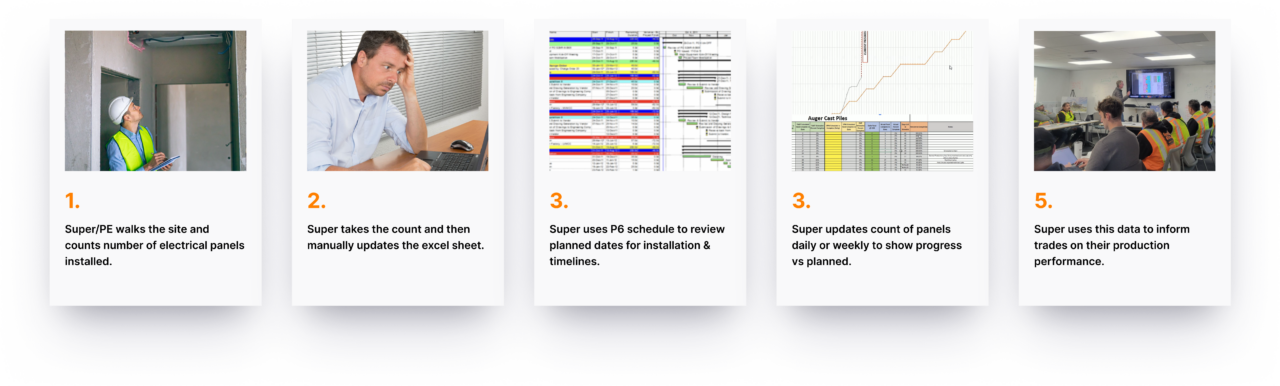
In major construction projects, the ability to plan, execute, and deliver on time and within budget is critical. However, one of the significant challenges many projects face is the lack of access to reliable production rates and the difficulty in creating accurate benchmarks. These data points are essential for informed decision-making, resource allocation, and performance tracking. Without them, project managers and teams often operate in the dark, leading to inefficiencies, cost overruns, and increased risk. The key challenges that arise when production rates are not readily available and benchmarks are insufficient, highlight the importance of overcoming these issues for project success. They include:
1. Inaccurate Project Estimations
2. Inefficient Resource Allocation
3. Poor Performance Tracking
4. Challenges in Continuous Improvement
5. Increased Risk and Uncertainty
Not having access to production rates and benchmarks in major construction projects can lead to a range of challenges, from inaccurate estimations to poor performance tracking and increased risk. Addressing these issues requires a concerted effort to gather, analyze, and utilize data effectively to create reliable benchmarks and optimize project outcomes.
Doxel is an automated progress tracking solution that provides real-time, objective data on construction performance. Unlike traditional methods that rely on manual tracking and subjective reporting, Doxel uses AI and computer vision to deliver frequent, precise, actionable insights. Doxel speeds up construction by automating progress reporting which surfaces hidden issues early, prevents rework, and enhancing collaboration with visual data.
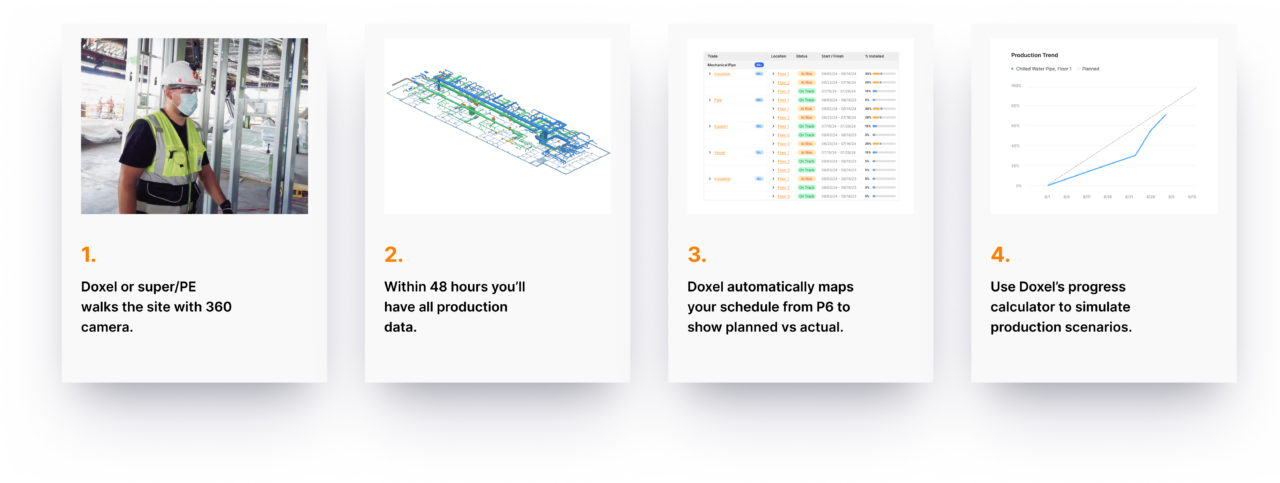
Doxel’s automated progress tracking leverages images from 360 degree cameras for reality capture by converting images into construction elements. This technology provides precise data on production rates, such as linear feet of conduit installed per week across multiple projects. By comparing this data across different trades, sites, and contractors, Doxel enables teams to create more realistic schedules based on actual performance metrics.
Owner’s reps, sometimes considered the Director of Construction, are responsible for fostering collaboration between stakeholders to bring data centers and large projects in on schedule and under budget. Consider a scenario where an owner has built multiple data centers using Doxel and has significant benchmark data on productivity rates for each stage in construction. This collaboration can provide enormous benefits when analyzing bids from the GC. Where project schedules are overly aggressive, project owners can challenge GCs on their ability to commit to accelerated schedules, fostering a sense of alignment. With Doxel’s historical production rate data, the GC can confidently assess the feasibility of the proposed schedule. The added transparency between the owner and GC, facilitated by Doxel, helps deliver projects on schedule using historical benchmark data.
Benchmarking: Use Historical Data to Set Realistic Schedules
Risk Reduction: Avoid Overcommitting and Mitigate the Risk of Delays
Informed Decision-Making: Make Data-Driven Decisions That Clients Trust
Enhanced Reputation: Deliver Projects on Time and Within Budget
In the construction industry, informed scheduling decisions are crucial for project success. Doxel’s production rate data provides insights to optimize schedules, reduce risks, and ensure successful project delivery. By leveraging this data, construction teams can confidently commit to achievable timelines and deliver exceptional results.
Ready to optimize your project schedules with Doxel’s production rate data? Contact us today for a demo and discover how Doxel can help your team achieve faster schedules with confidence and reduced risk.
By incorporating these insights and leveraging cutting-edge tools like Doxel, construction teams can navigate the complexities of project scheduling with greater certainty and efficiency.

With automated tracking, construction teams can ensure that 'almost done' quickly becomes 'completely done.
Let’s face it: Getting stuff done is hard. And getting stuff done in the face of today’s shortages, supply chain issues, and inflation is a daunting task for any construction company. Automated construction progress tracking can help you finish projects faster.
Before we get into that, let’s take a closer look at what’s going on.
Less people from younger generations are choosing a trade or apprenticeship. As a result, the industry is facing a shortage of skilled workers to help complete project milestones. Without knowing how many people can get the work done (and get it done correctly), companies struggle to stay on track.
Those who do choose to go into construction today are still green in their careers and don’t have the experience that seasoned employees do. This creates a learning curve and requires additional time needed to get them up to speed.
Unpredictable factors create unpredictable change—and change requires an added degree of flexibility for the project to adapt to the circumstances. As a result, companies are seeing more design changes come through, and the need to stay on top of assessing and documenting them.
Speaking of unpredictable, the industry ha seen an influx in supply chain issues, causing delays in shipments and—in some cases—a limited supply of the necessary materials available.
Across every industry, prices are going up. Companies must now reconcile their bids and project scopes to maintain profitability.
When the going gets tough, construction stays tougher. The industry is no stranger to uncertainty. Now more than ever, companies need to pinpoint areas of improvement and streamline their processes to maximize efficiency.
With all these factors weighing on a project’s productivity, the margin for error is very low—which means operational excellence is critical for success. Many projects get to a certain stage or near completion, but struggle to accurate assess what’s happening (or not) to get the rest of the way there.
Almost done isn’t done.
If the last 10% of a milestone takes more than 20% of the time—that’s a big, potentially costly, problem.
That’s where automated construction progress tracking comes in. With the right technology in place, companies can save 25% of superintendents’ and field teams time that would otherwise be spent on tracking progress and bringing everyone on the same page. That’s less time in meetings and back-and-forth conversations, more time building.
Real-time automated construction progress tracking gives everyone on a project visibility into the current state, without the need for individual communication. This ensures the project moves as quickly as it can and prevents trade stacking.
Stay on top of milestones with the ability to forecast and predict any slowdowns before they happen—instead of catching them after it’s too late. By automatically capturing more than 75 stages of construction, automated construction progress tracking technology can spot potential issues more efficiently in real time.
By providing accurate and automated cost budget analysis, companies are able to better understand their project and where it stands with the budget. When unforeseen factors or delays hit, you want all the knowledge and numbers you can get to properly adapt and minimize the impact.
In construction, communication can be slow and sparse. Automated construction progress tracking gets everyone on the same page without having to meet to discuss. Having a digital surveyor gives everyone the information and insights they need to collaborate faster—without relying on project resources to collect and report on it.
No matter what gets thrown at the construction industry, a company needs to be resilient and smart to see success on the other side. Companies who invest in the right tools that save time and automate processes have the advantage of receiving data and insights in real time. The faster something is flagged, the faster it can be fixed.
Want to learn how Scripps Health and McCarthy Building Companies are automating construction progress tracking to increase project visibility? Register for our upcoming webinar Almost Done, Isn’t Done.

Streamlining the process for creating detailed reports can free up the project team's focus while enhancing the level of reporting and insights for a company.
In a 2021 Workforce Survey Analysis, AGC found that 88% of companies surveyed were experiencing project delays—that’s nearly nine out of ten. Now more than ever, construction companies are faced with the challenge to do more with less and keep projects on track in the face of unforeseen circumstances.
While certain conditions and factors in the industry can’t be controlled, there are 3 construction workflows that can reduce the margin of error to ensure a project stays resilient. This requires operational excellence in the areas that can be predicted and made more efficient.
What are the three construction workflows a company should prioritize?
Communication among field teams, supervisors, and the office is crucial—and can be cumbersome. With so many moving pieces of a project happening at once, getting the necessary message out to everyone in a timely, effective manner is no easy feat.
Companies need to find a way to remove the barriers to communication. By doing so, they’ll save everyone on the project team valuable time that would otherwise be spent tracking progress, in meetings to get everyone up to speed, or playing telephone.
Quality of construction can make or break a project’s ability to stay on track. Quality issues or mistakes found too late in the process can be the kiss of death for moving onto the next phase—and as a result, teams remain stuck in the final 10 or 20% of completion for too long. This won’t just cost time and manpower, it’ll directly affect a project’s budget and profitability, too.
The only option to streamline and prevent these costly quality issues is to catch them early and address them quickly. Technology that helps companies see progress in real time opens the door for making smarter decisions and adapting faster.
When a project does make it through the final 10%, the work isn’t over yet. Teams must provide an objective, detailed overview of the completion—which again takes time and resources. There’s more information to gather, and no efficient way to compile it using manual efforts alone.
Teams should be focused on projects, not paperwork or reporting. Streamlining the process for creating detailed reports can free up their focus while enhancing the level of reporting and insights for a company.
By implementing a technology that can continuously monitor performance and provide predictive insights, construction companies are able to achieve operational excellence.
Platforms like Doxel act as a digital surveyor to automatically track progress across more than 75 different construction stages in real time, freeing up the project team’s time and resources.
Instead of manually walking the jobsite every day or week to capture exact progress, Doxel works with a 360° video to act as a digital surveyor in minutes. Combining the power of computer vision with BIM means companies have an objective truth of the status of a site—and can understand progress, schedule, and budget better than ever before.
If it sounds too good to be true, it isn’t.
Tune in to our webinar Almost Done, Isn’t Done to hear from two successful construction companies on how they’re leveraging real-time progress tracking to automate and achieve more.

By continuously tracking and analyzing construction site progress in real time, Production Rate Data serves as a single, reliable source of truth for measuring construction progress.
Traditionally, project managers have relied on site visits and progress reporting from their field teams to stay abreast of construction progress. On large capital projects like data centers, semiconductor wafer fabrication plants, or healthcare infrastructure this can become problematic where even small schedule delays lead to large cost overruns. Doxel’s Production Rate Data provides a solution that empowers project teams with additional data in order to monitor construction progress.

Production Rate Data is the information gathered through reality capture inputs (e.g., 360-degree imaging or drone footage), to continuously track and analyze construction site progress in real time. By comparing actual work completed against the planned schedule, this data serves as a single, reliable source of truth for measuring construction progress. It provides project owners with objective, accurate insights that are crucial for managing schedules and ensuring on-time project completion. This innovative approach equips teams with the data needed to identify delays, optimize workflows, and ensure efficient project delivery.
By leveraging this advanced technology, owner’s representatives can monitor projects with a data set they control, guaranteeing transparency and accuracy. Here’s how Doxel tracks completed construction:
Example: Mechanical Pipes and Walls

Doxel’s Production Rate tracking capability simplifies the comparison of completed construction against the schedule, offering a powerful tool for project owners to measure progress and manage schedules effectively.
Understanding how construction software tracks progress can be complex. Doxel simplifies this with a robust methodology:

Productivity is calculated using specific units of measure for each stage based on your work breakdown structure (WBS) in Primavera P6. For example, if the plumbing installation requires 100,000 linear feet of pipe, the unit of measure would be linear feet. The planned number would be 100,000, against which completed construction is measured.
As construction progresses, Doxel updates the number of completed activities. For instance, if only 20,000 linear feet of pipe have been installed for the drainage system, the 360-degree imaging would capture the work, and Doxel would update the percentage of completion for both the stage (drainage system) and the trade (plumbing) to 20%.
To help manage schedules effectively, Doxel introduced the Production Forecasting Calculator. This tool allows users to simulate different scenarios by adjusting crew sizes and production rates to forecast completion. General contractors can manage subcontractors to ensure they stay on schedule. At the same time, owner’s reps can monitor production rates remotely, gaining confidence that construction progress is on track based on actual data.
Production Rate Data compares completed construction against your schedule, providing a single source of truth for measuring construction progress. Doxel’s system allows you to manage productivity for each stage of the construction project by trade, zone, and floor. This capability empowers project owners with a controlled data set that facilitates better communication with general contractors and helps address potential schedule delays proactively.
By giving project owners control of the data, Doxel ensures a higher level of transparency and efficiency in construction management. This innovative approach enhances collaboration and significantly reduces the risk of delays, optimizing time and resources. With Doxel’s Production Rate Data, project owners can confidently steer their projects to successful completion.

Accurate and reliable progress tracking is essential for effective communication and coordination, especially with multiple stakeholders and a higher level of complexity. Automated construction progress tracking can meet these requirements and reduce manual effort, helping you complete your projects faster and on-budget.
Healthcare construction is more complex and has a lot at stake. If not done right, these projects can be costly for everyone involved. Healthcare projects also require a higher attention to detail to keep everything running smoothly.
With more stakeholders involved in the process, companies need to be able to benchmark and be equipped for better prediction, transparency, and ultimately the ability to detect (and curb) problems, deviations, and cost overruns.
Automated progress tracking can meet these requirements and reduce manual effort, helping you complete your projects faster and on-budget.
Progress tracking is critical for project success in healthcare because it allows for real-time monitoring of project performance and a faster identification of issues and challenges, and implementation of corrective actions.
By regularly monitoring progress and performance, project managers and teams can quickly identify areas that are falling behind schedule or budget—and take the necessary steps to address them before they become major issues. Accurate and reliable progress tracking is essential for effective communication and coordination, especially with multiple stakeholders and a higher level of complexity.
Progress tracking can be beneficial beyond one single project, too. Objective progress data and insights can also help to identify areas of success and best practices that can be replicated in other projects, improving overall project performance and company-wide outcomes.
Automated progress tracking can improve transparency during hospital construction by providing real-time, accurate information on the progress of the project. Automated systems can be configured to collect data from a variety of sources, create a single source of truth and present the information in a format that is easy to understand and always accessible.
With the enhanced, real-time visibility that automated progress tracking brings, stakeholders are able to see exactly where the project is at any given time. This clear picture of project status helps improve communication, transparency, and accountability with objective data that eliminate any debate in progress tracking.
Automated progress tracking is a faster way of providing stakeholders with access to the same information. With an automated system, stakeholders are able to see the same data and reports, regardless of their location. Ensuring everyone is working with the same information saves time in reporting and mitigates the possibility of miscommunication or misunderstanding.
Since hospital construction projects often involve large sums of money and have a significant impact on patient outcomes, it’s also useful to have an auditable record of each project’s progress that can be used in demonstrating accountability to funders and regulatory bodies.
Healthcare construction projects need an efficient way to manage and mitigate risk. Proper real-time visibility into the progress of the project can help spot potential issues before they become major problems. This enables project managers and other stakeholders to take proactive measures, rather than waiting until it is too late to take corrective action.
For example, if progress tracking reveals a particular aspect of the project is running behind schedule, the project manager may be able to adjust the project plan to effectively avoid potential delays or cost overruns.
Additionally, progress tracking can help project managers manage and coordinate dependencies between different parts of the project, which further reduces the risk of delay, prevents trade stacking, and mitigates other issues arising from one part of the project impacting others.
Progress tracking can help with benchmarking by providing a clear understanding of the current status of the project, including the status of all trade and any related delays or setbacks. This data can then be used to compare the project’s progress against similar projects or industry standards, making it easier to identify areas where improvements can be made.
With multiple sources of information on a single project, a digital progress tracking tool can deliver accurate data to one shared source of truth, making benchmarking markedly easier.
Additionally, progress tracking stored data can be leveraged for benchmarking future progress against previous internal projects for better forecasting future project and completion dates, as well as for identifying potential cost savings or other opportunities to optimize the project.
The more detailed information teams have on the progress of a project, the more proactive they can be to keep it on track. Identifying potential issues early on allows for corrective action to be taken sooner rather than later, reducing hours, rework, and delays to deliver projects on time and on budget. But detailed and timely progress tracking shouldn’t come at the cost of crews’ time and resources.
That’s where a solution like Doxel’s automated progress tracking can help. Doxel significantly reduces hours tracking progress, while delivering accurate, reliable objective insights that improve communication and transparency across all stakeholders.
Click here to learn more about how Doxel’s AI-powered progress tracking paired with 360-degree video capture can help ensure hospital construction projects stay on track and on budget.

Healthcare construction teams that leverage AI-powered performance monitoring are armed with accurate data in near real-time to keep projects on track.
Healthcare construction is a specialized niche in the industry, and the projects within it require a high standard of attention to detail to meet their deadlines. These projects are complex and involve the coordination of large, cross-functional teams to complete them on tight schedules—which means a project’s success is majorly dependent on the efficiency and collaboration of the team building it.
Every day that the facility is delayed or past schedule means another day patients can’t come in, and the owner or company will lose money.
Enter, AI-powered project controls – automated construction progress tracking.
The construction of healthcare projects is a delicate balance of innovation and realism. As one of the more technology-driven sectors, these facilities aim to have the latest and greatest equipment, but at the same time needs to be planned months in advance and available within a certain deadline. Teams must stay on top of an ever-changing landscape and varying demands—so having accurate, objective project progress data throughout is essential.
One of the biggest factors to staying on schedule is knowing exactly where you are. Without a single view of project progress, sticking to a set schedule becomes a risky guessing game. Progress tracking using the power of computer vision enables project teams to build faster and more accurately together.
After all, knowledge is power. Teams that leverage AI-powered performance monitoring are armed with accurate data in near real time to see backwards at what’s been done, as well as ahead at predictive insights.
Rework can be a project schedule’s worst nightmare—and the later it’s caught the bigger a scheduling headache you have on your hands. Rework takes valuable time away from what should be forward progress. In order to achieve schedule predictability, a project team has to be able to spot (and avoid) potential rework on the critical path.
Using computer vision automated construction progress tracking that acts as a digital surveyor, superintendents can quickly catch any missing or incorrectly installed components before the next trade covers up the error. This foresight can help avoid weeks of delays and schedule compression, which ultimately helps the facility stay on track to open on time or earlier.
Real-time automated construction progress tracking doesn’t just help with new healthcare construction—it can also help reduce downtime during facility operations down the road.
Picture it (if you dare): A construction company closes off an area to cut into the wall and fix MEP services only to discover that it wasn’t installed per as-built plans. Instead of adhering to the plan, dreaded rework is now required.
But what if you had x-ray vision instead? Comprehensive reality capture of an as-built facility ensures maintenance teams know exactly what was installed and where, so any maintenance and retrofits can be done efficiently without the rework. Instead of costing days of downtime, teams can get in and get it done as planned the first time.
At its core, Doxel is automated construction progress tracking that provides objective, accurate data on materials installed for real-time project controls. The more teams can document in the moment, the more productive and proactive they become.
Find out how healthcare projects have used Doxel to deliver facilities earlier and at a higher standard of quality.
See how AI-powered progress tracking helps data center teams identify schedule risks earlier and build with confidence.
Doxel is heading to Singapore for Data Centre World Asia 2026, taking place September 29–30 at the Sands Expo & Convention Centre as part of Singapore Technology Week. As an LED Wall Sponsor, Doxel will showcase how AI-powered Work-in-Place (WIP) tracking and schedule analytics help project teams identify schedule risks earlier, improve coordination, and make faster decisions throughout construction. Come visit us at booth 3G2.
Southeast Asia's data center pipeline has moved fast over the past two years. Singapore is a central hub for hyperscalers, colocation providers, and contractors racing to deliver capacity across a region where power, land, and skilled labor are tighter constraints than in more established markets.
That pressure shows up on the jobsite. Compressed schedules, fragmented regional supply chains, and delivery models that vary market to market all make it harder to know, with any confidence, where a project actually stands. Teams are still leaning on manual walk-throughs and self-reported updates to answer a basic question: is the work installed, and is it on pace with the plan?
Data Centre World Asia brings the people wrestling with that question into one room — five concurrent tracks covering the Global Stage, Keynote Theatre, Energy Security & Efficiency, Critical Infrastructure, and OCP Tech Day. It's a good cross-section of where APAC data center construction is headed, and exactly the audience we built Doxel for.
Doxel turns weekly site walks into objective, component-level progress data, tracking installed work against the plan, flagging schedule risk early, and giving owners, GCs, and trade partners a shared, factual view of where a project stands. No more disputes over whose version of “done” is right.
Teams using Doxel get:
• Automated progress tracking tied directly to the schedule
• Earlier visibility into delays, before they become critical-path problems
• A single source of truth that keeps owners, GCs, and trades aligned
• Benchmarking across projects to spot where production is slipping
For a region building as many facilities, as fast as APAC is right now, that kind of visibility isn't a nice-to-have; it's what keeps a portfolio of projects on schedule.
Doxel's team will be at booth 3G2 throughout the show: Spencer Clayton, Dom Pound-Palmieri, Jesse Gill, Hamza Abukar, and Sridhar Rengasamy, our APAC Lead. Sridhar has spent years working on large-scale infrastructure projects across Southeast Asia and is happy to share his expertise on the region.
If you're attending Data Centre World Asia and want to talk about a live or upcoming project, stop by booth 3G2 or reach out to Sridhar on LinkedIn to set up time.
We'll see you in Singapore.
LCI Congress 2026 is the place to be to see how AI-powered progress tracking gives Lean construction teams objective visibility into project progress, helping improve planning, coordination, and delivery.
Doxel is excited to return as a sponsor of LCI Congress 2026, where owners, contractors, designers, and Lean practitioners will explore the strategies and technologies shaping the future of project delivery. Taking place October 12-16, 2026, in Atlanta, Georgia, LCI Congress brings together construction leaders focused on improving collaboration, reliability, and continuous improvement.
Date: Thursday, October 15, 2026, 3:45-4:30 PM
Panelists:
- Moderator - Chris Vine, LCI-CPC, DBIA, CM-Lean Champion, Project Superintendent, Hensel Phelps
- Speaker - Brandon Bergener, Sr. Superintendent, Layton Construction Company LLC
- Speaker - John Rewolinski, Head of Schedule Analytics, Doxel
Lean construction depends on accurate, timely information. Yet many teams still rely on manual jobsite walks and spreadsheets to understand project status.
Doxel's AI-powered Work-in-Place (WIP) tracking gives Lean teams objective, real-time visibility into construction progress, helping project teams compare plan versus actual performance, improve coordination, and identify schedule risks earlier.
Whether supporting Last Planner System®, Takt planning, or flow reliability, Doxel provides trusted progress intelligence that helps teams make faster, more informed decisions.
Stop by Booth #113 to learn how leading construction teams are using AI-powered progress tracking to:
We're also proud to sponsor the LCI Congress Golf Tournament, including Hole #6 and the TaylorMade Golf Kit giveaway.
LCI Congress 2026 | October 12-16, 2026
Signia by Hilton | Atlanta, Georgia
Visit Booth #113 to how AI-powered progress tracking is helping teams deliver projects with greater certainty, consistency, and confidence.
The conference brings together leaders focused on solving the biggest challenges in AI infrastructure, including prefabrication, digital construction, power availability, and accelerated project delivery.
Doxel is heading to the Builtworlds Buildings Conference: Data Centers & AI Infrastructure to demonstrate how AI-powered progress tracking helps owners and contractors reduce schedule risk and accelerate data center delivery.
AI infrastructure projects are growing larger, faster, and more complex, making objective progress visibility more important than ever.
The event takes place September 30 to October 1 in Nashville, Tennessee. As a Premier Sponsor, Doxel will showcase how AI-powered Work-in-Place (WIP) tracking and schedule analytics help project teams identify schedule risks earlier, improve coordination, and make faster decisions throughout construction.
Thursday, October 1 | 2:10 PM – 2:50 PM
Speakers
What is reality on your jobsite? Your P6 says one thing, your trade partners say another. On a hyperscale data center, having near real-time, objective progress data helps you make better decisions to stay on schedule. In this session, a DPR superintendent and Doxel product leader share real stories from the field: catching a piping trade's slide months before it became a crisis, discovering security rough-ins installed three feet off design, and proving drywall was way ahead of schedule to a skeptical client with a single click.
Join Reid Senescu and Mike Miller as they share how computer vision turns weekly 360° site walks into objective, component-level progress data that keeps trades on plan, settles disputes with evidence instead of arguments, and drives the coordination conversations that build data centers faster. You'll leave with practical adoption lessons—including why a dashboard on the wall beats a hyperlink in an inbox every time.
This year's conference focuses on the challenges shaping modern AI infrastructure, including prefabrication, digital construction, power availability, and project delivery. These priorities align closely with Doxel's AI-powered Work-in-Place (WIP) tracking and schedule analytics, giving project teams objective insight into progress so they can reduce risk and make faster decisions.
Visit Doxel during the conference to learn how leading data center teams are using AI to:
We look forward to connecting with owners, contractors, and technology leaders at BuiltWorlds to discuss how AI-powered progress tracking is helping deliver the next generation of data centers with greater certainty.
Doxel is proud to sponsor DCD Connect London 2026, joining Europe's leading data center owners, developers, contractors, engineering firms, and technology providers to explore the future of AI-powered data center construction.
Europe's data center market is entering a new phase of growth. AI infrastructure, power availability, sustainability mandates, and gigawatt-scale developments are reshaping how projects are planned and delivered, and owners and contractors need greater visibility into performance to keep pace.
Doxel is sponsoring DCD Connect London 2026, joining Europe's leading data center owners, developers, contractors, engineering firms, and technology providers for two days of industry insight and collaboration. Held September 16–17 at the Business Design Centre in London, the event brings together more than 5,000 industry leaders, 150+ exhibitors, and 280+ speakers shaping the future of digital infrastructure.
Data center development is expanding beyond traditional FLAP-D markets into the Nordics, Mediterranean, and Eastern Europe, even as developers navigate grid constraints, evolving sustainability regulations, labor shortages, and increasingly aggressive delivery schedules. In this environment, accurate progress tracking and early risk identification aren't optional; they're what keep gigawatt-scale programs on schedule.
Doxel replaces manual reporting with automated progress tracking to keep teams aligned with hard facts that leave no ambiguity on where the project is today, where it will be tomorrow, and what decisions need to be made to land it on schedule and on budget. With Doxel, construction professionals have full observability on their site while providing their field teams with the powerful tools they need to prevent delays, over-billing, rework, and trade stacking.
Visit Doxel to see how leading project teams use AI to:
Whether you're delivering a single hyperscale facility or managing a multi-campus portfolio, Doxel gives you the construction intelligence to reduce uncertainty and improve outcomes.
Event Information
Event: DCD Connect London 2026
Dates: September 16–17, 2026
Location: Business Design Centre, Islington, London, UK
Book a meeting with the Doxel team at DCD Connect London to see how AI-powered progress tracking is helping Europe's data center builders deliver with greater confidence and control.
Doxel is heading to DCAC USA 2026 on August 24-26 at the Austin City Limits Live, Moody Theater. Come see us on “The Porch” on August 24th-26th.
Known as “The People’s Conference,” DCAC USA has become one of the most respected operator- and builder-focused gatherings in the data center industry. As a Gold Partner, Doxel will join data center owners, operators, engineers, contractors, and delivery leaders for candid discussions around the realities of building critical infrastructure at scale.
DCAC USA brings together the industry's top owners, developers, contractors, and technology innovators for three days of networking, collaboration, and conversations driving the future of mission-critical construction.
As AI infrastructure expands, project teams need better visibility and more reliable ways to deliver increasingly complex construction programs. Doxel's AI-powered Work-in-Place (WIP) tracking and schedule analytics provide an objective view of construction progress, helping teams identify risks earlier, improve coordination, and make faster, more informed decisions.re using AI to:
The next challenge in data center construction isn't building one project. It's building the next project more efficiently than the last.
Doxel is excited to attend the Data Center Investment Conference & Expo (DICE): South, where data center developers, owners, contractors, and technology leaders will explore the strategies shaping the next generation of AI infrastructure.
Texas continues to lead the nation's data center expansion, fueled by unprecedented AI demand and billions of dollars in new investment. Recent announcements include major financing for new Texas campuses and hundreds of planned projects across the state, reinforcing the region's position as one of the world's fastest-growing data center markets.
Delivery at Scale: How to Move From One-Off Wins to a Repeatable System

Panelists:
Location: Dallas, Texas
Dates: Wednesday, Aug 12-13, 2026
Event Page
As AI infrastructure expands from single facilities to multi-campus programs, contractors must deliver consistent results despite labor shortages and increasingly aggressive schedules. John Rewolinski will join industry leaders to discuss practical strategies for building repeatable delivery systems that improve project performance at scale.
Doxel's AI-powered Work-in-Place (WIP) tracking and schedule analytics give teams objective, real-time visibility into construction progress, helping them identify risks sooner, improve coordination, and make faster decisions.
Visit Doxel at DICE South to see how leading data center builders are using AI to:
Learn how Doxel is helping data center teams deliver faster, with greater confidence and consistency.
Doxel is heading to DCAC Europe 2026 on June 23–24 at The Roundhouse in London. See us on "The Balcony" during the event on June 24.
Known as “The People’s Conference,” DCAC Europe has become one of the most respected operator and builder-focused gatherings in the data center industry. The event brings together owners, operators, engineers, contractors, and delivery leaders for candid discussions around the realities of building critical infrastructure at scale.
Unlike larger corporate trade shows, DCAC Europe is intentionally designed around community, practical conversations, and operational insight. The event consistently attracts the people directly responsible for solving some of the industry’s most challenging problems.
“We are in the middle of the fastest industrial shift in human history — the 5th Industrial Revolution. AI, compute, power, labor, land, capital, and community trust are colliding in real time, yet the world still fundamentally misunderstands the sector making it all possible.
Data centers are not background infrastructure. They are the front line of the AI era. That disconnect is no longer just frustrating. It is actively dangerous.
Misconceptions around our industry are slowing workforce development, delaying policy clarity, impacting community trust, and creating friction across project execution and capital deployment. This year, DCAC is focused on confronting that narrative head-on.” - DCAC Team
DCAC Europe brings together the people responsible for building and operating some of the world’s most complex data center projects.
That is why Doxel continues to attend year after year.
The event creates valuable opportunities to connect directly with teams focused on improving construction performance, increasing schedule certainty, reducing risk, and delivering projects faster with greater predictability.
Doxel helps owners and contractors gain objective visibility and actionable insights into construction progress through AI-powered progress tracking. By comparing field conditions against BIM models and schedules, teams can identify risk earlier, improve coordination across trades, and make faster, more informed decisions.
Instead of relying on subjective updates or delayed reporting, project teams gain measurable visibility into actual production progress across the jobsite. This allows teams to understand what is truly complete, what is falling behind plan, and where intervention may be needed before delays compound.
On major projects, Doxel has helped teams move beyond subjective “rule of thumb” tracking toward objective production benchmarking and real-time operational insight.
This level of visibility becomes increasingly important on fast-moving data center projects where even small coordination issues can create cascading schedule impacts across multiple trades and work areas.

Representing Doxel at the event includes Faiz Alidina, Director of Sales, EMEA, Ken Denning, David Brody, Hamza Abukar, and Dom Pound-Palmieri.
Doxel will also participate in the networking and community events surrounding DCAC Europe, including the DCAC Charity Golf event on June 23 at Sudbury Golf Club.
If you are attending DCAC Europe 2026, connect with Doxel to learn how leading data center teams are improving visibility, predictability, and execution certainty across complex construction programs.
Event website: DCAC Europe 2026
From June 2–4, Doxel will join thousands of leaders across the global data center ecosystem at the 2026 Datacloud Global Congress (DGC) 2026 in Cannes, France.
Held at the iconic Palais des Festivals et des Congrès, Datacloud Cannes brings together hyperscalers, developers, investors, operators, and construction leaders shaping the future of AI infrastructure and digital capacity expansion.
With more than 6,000 attendees expected, this year’s event arrives at a critical moment for the industry. AI demand continues to accelerate the construction of data centers globally, while labor shortages, power constraints, and schedule pressures continue to intensify.
As a Silver Sponsor, Doxel will be exhibiting at Booth #317 with full EMEA sales, product, and customer coverage on site, including participation in the event’s pre-conference cycling activities.
The conversations at DGC align directly with the challenges Doxel helps solve every day on large-scale projects.
Across the industry, owners and builders face mounting pressure to deliver complex facilities faster while maintaining quality and reducing risk. At the same time, construction productivity continues to lag behind other industries despite increasing project complexity and demand. For data center teams building hyperscale campuses and AI infrastructure, delays and missed coordination windows can quickly create cascading schedule impacts.
That is why objective, real-time construction visibility has become increasingly important.
Throughout Cannes, Doxel will showcase how leading owners and contractors are using AI-powered progress tracking to improve schedule certainty, benchmark production, and reduce costly surprises in the field.
Doxel automatically captures and analyzes site progress against BIM models and schedules, giving teams real-time visibility into what is actually happening on site. The platform eliminates the delays and inconsistencies that come from manual reporting and subjective progress tracking.
On major projects, Doxel has helped teams move beyond “rule of thumb” project management by introducing objective production benchmarking and real-time performance insights. DPR Construction used Doxel to improve benchmarking consistency and increase confidence in decision-making across projects.
As owners demand greater predictability and transparency across capital programs, Doxel gives teams what traditional reporting systems often cannot: a live operational view of project execution.
To support our efforts at Datacloud Cannes, we are launching a digital billboard campaign across key areas surrounding the Palais des Festivals and La Croisette.
The campaign reinforces a core message increasingly resonating across the data center market:
You cannot accelerate delivery without objective visibility into production.
The creative highlights our ability to help owners and builders deliver construction faster through automated progress tracking, real-time production insights, and proactive risk detection.
The campaign also reflects a broader shift happening across construction. Owners are beginning to manage construction investments with the same operational rigor applied across the rest of their business.
Attendees can meet with our team throughout the event to discuss how AI-powered construction analytics are helping data center teams improve execution certainty at scale.

If you are attending Datacloud Cannes 2026, stop by Booth #317 to see how we’re helping teams deliver complex projects with greater speed, visibility, and confidence.


